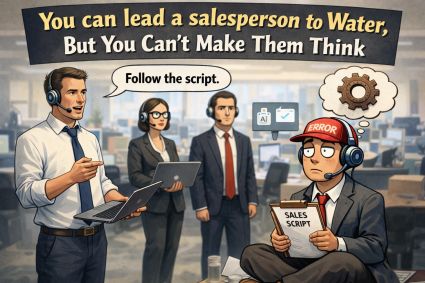
We’ve built something remarkable in modern sales organizations. Over the past two decades, we’ve constructed an elaborate infrastructure: scripts, playbooks, sequences, talk tracks, battle cards, cadences. We’ve constructed metrics tracking every activity, with performance dashboards providing red/yellow/green signals. We’ve built tech stacks that are the envy of our competitors.
These have all been designed, theoretically, to drive consistent, scalable growth.
But there’s a problem. In our pursuit of consistency and activity, we have systematically designed thinking out of the profession.
And now AI is making that visible.
We started with good intentions. Sales leaders looked at their top performers, tried to decode what made them great, and packaged it into a process everyone else could follow. “If you just say these words in this order, you’ll get results.”
And to be fair, it works. We want to understand what top performers do and use that as a model to drive the performance of everyone else.
But here’s what we missed. We modeled the things that were observable: the process, the questions, how they handled objections. We couldn’t model the curiosity, the critical thinking, the discipline and accountability. Those were invisible, and invisible things don’t make it into playbooks.
So as we scaled, rather than providing a framework to focus thinking, we designed thinking out. The goal became compliance: follow the script, stick to the playbook, hit your activity goals. We selected for compliance.
For a while, it seemed to work. We got more consistent execution. In transactional sales, this approach produced results. In complex B2B, people struggled, but that was masked by the mantra of “doing more.” And now the doing-more strategy is failing.
The metrics reinforce the problem. Activity metrics reward doing, not thinking. Make 60 calls. Send 200 emails. Book 15 meetings. Run the sequence.
Nobody gets rewarded for spending 45 minutes reading a customer’s 10-K before a discovery call. Nobody gets recognized for mapping the dynamics of a buying group in developing their strategy. People who do this get penalized for not hitting their activity metrics, while many are still overachieving their quotas.
We’ve built measurement systems that treat selling like a factory floor. More widgets per hour. More throughput. The problem is that customers aren’t widgets, deals aren’t assembly lines, and the complex, high-stakes conversations that actually create value can’t be reduced to a production metric.
Now layer AI on top of this.
We have more data about our customers than at any point in history and less actual understanding of them than ever.
AI has amplified that gap. It generates more personalized emails at higher volumes. It provides deeper research and call prep than even the best sellers could produce on their own. It gives sellers the illusion of insight.
But this isn’t really insight. It’s pattern matching, not understanding.
And sellers discover this when the customer responds with, “tell me more…. Or, that’s not an issue for us.”
How many sellers are actually reviewing, critiquing, and tuning those AI-generated emails before they’re sent? How many are looking at the research to really understand what’s happening with the customer and how to use it in the meeting? How many are doing anything going through the motions.
The first mistake is thinking the seller no longer needs to understand the customer’s business, their challenges, or the pressures their executives face. The second mistake is thinking AI provides that understanding. It doesn’t. AI analyzes patterns across every similar situation in the world, most of which are irrelevant to what’s happening with this customer, in this moment, in this deal.
Sellers are surrendering the thinking to AI. But AI can’t sense what the customer isn’t saying. It can’t read the room. It can’t engage in a conversation that makes a customer stop and think, “This seller gets it!”
For salespeople who already think well, who bring curiosity, business acumen, and insight to their work, AI is a multiplier. It handles the tedious work so they can focus on what matters.
But for those who were trained not to think, AI destroys whatever capability they might have had. They become dependent on what the algorithm tells them to do.
And this is happening at the worst possible moment. The buying environment has never been more complex. More stakeholders on every decision. Longer cycles. More ambiguity. Constant shifts in direction and priority. Buyers are drowning in information and starving for insight.
Working with these customers demands the most thinking from salespeople, but designed thinking out of the process.
Just what the customer needs most, we’ve minimized the capability of sellers to be helpful.
What happens when the customer asks a question the script doesn’t cover? How do we leverage the research AI provided to understand what it really means to this customer? How do we respond when the customer’s reality is different from our playbook?
Our sellers can’t do it. Not because they’re incapable, but because we never asked them to be capable. We never developed that muscle. We never rewarded it. We never even measured it.
Customers recognize this immediately. They know the difference between talking to someone who’s thinking and someone who’s executing a sequence. They can sense when the questions are scripted versus curious. They know when the “insight” in an email was generated by a machine that knows nothing about their situation.
Increasingly, they’re choosing not to engage at all, the research shows that “buyers don’t want to talk to salespeople anymore.”
We misunderstand what this really means. Buyers want and need help. It’s just that sellers aren’t being helpful. Buyers don’t want to be on the receiving end of a script or playbook. They aren’t interested in a process that serves the seller but doesn’t help them solve their problem.
But if a seller understands their world, who’s done the work, asked the hard questions, and brought insight they hadn’t considered. Buyers will make time for that person.
This isn’t just about sellers. We can’t ignore the role management plays in creating this environment.
The manager’s job is to maximize the performance of each person on their team. They are supposed to be developing their people’s ability to analyze situations, develop strategies, navigate complexity, and engage their customers in collaborative business conversations. When a customer has a different script, they want their people to figure things out.
Instead, most have become compliance monitors. They inspect dashboards, not deal strategies. They review activity metrics, not the quality of customer conversations. In coaching sessions, the question is “did you follow the process?” not “what did you learn about this customer?” or “what’s really going on in this deal?”
When a deal stalls, the reaction is to see if the playbook was followed, rather than sitting down with their people and thinking together: “How do we get this moving again?” Just as we have designed thinking out of seller roles, we’ve done the same with too many manager roles. Rather than helping figure things out, they monitor dashboards, audit activities, and suggest, “You need to start hitting your activity goals!”
AI-powered coaching tools threaten to make this worse. The AI tool is a better compliance monitor than a manager. It can say, “you need to hit your activity goals” more quickly than the manager.
The manager no longer needs to be engaged; they can inspect what the AI tool is showing, then ask the tool to work on it with their people. As a result, the manager gets more distant from what’s really happening, with their people and their customers.
The answer isn’t to throw out AI or abandon the process. Both have their place. Structure gives people a framework. AI handles mechanical work faster and more consistently than humans ever could.
But we have to stop treating process and AI as substitutes for thinking and start treating them as inputs to thinking.
This means we have to change. We have to hire differently — focusing on people who demonstrate curiosity, business acumen, the ability to think on their feet, discipline, and accountability. We have to measure differently — finding ways to value the quality of customer engagement, not just the quantity of activity. We have to develop differently — building thinking skills alongside selling skills, teaching people how to research, analyze, question, and construct insight. We have to manage differently — turning coaching from inspection into collaborative thinking about customers, deals, and strategy. And we have to deploy AI differently — as a tool that frees people to think more, not a replacement that lets them think less.
The organizations that will win in the next decade are the ones that figure this out. They’ll use AI to handle what machines do best so their people can do what only humans can: think, connect, create insight, challenge assumptions, and earn the right to a customer’s time.
Because you can lead a salesperson to the finest tools, the smartest algorithms, and the most sophisticated playbooks ever built.
But you still can’t make them think.
Unless you decide that thinking is what actually matters — and build everything around that.
Afterword: A great AI-generated discussion of this article. What I love about these discussions is that they always have a slightly different perspective. I took a few notes from their discussion and edited the original article. Enjoy!

Leave a Reply