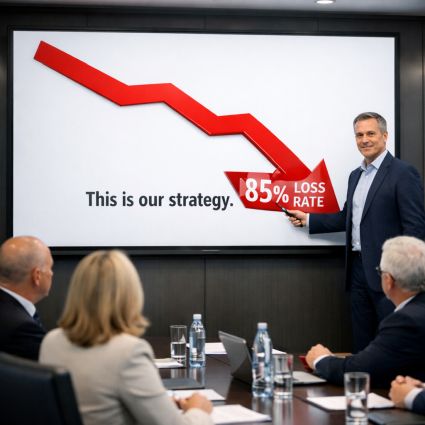
Imagine a CRO presenting to the exec or investor team. This CRO is presenting their GTM strategy, and a key statement in that strategy is, “We are competing and hoping to lose 80-85% of the deals we invest in!”
We all know what happens. That CRO is sent packing, a new CRO is brought in, a new playbook. Three months later, we see, “We are competing to lose 80-85% of our deals!”
This strategy is unspoken. Few would call it a strategy, but it’s pervasive in so many organizations, particularly in the tech sector. The way it’s expressed is, “We have a 15-20% win rate.” All activities are oriented around this. We calculate healthy pipeline metrics so we know the number of qualified deals we need to achieve our goals. We calculate the number of SQLs, Calls, MQLs, outreach emails that can generate that pipeline for us.
Somehow, we make our numbers, we celebrate and look at how we scale.
And we know the math behind that. If we want to double in the coming year, we simply double the metrics referenced above. We expect our people to do more, so we leverage AI. And we may have to hire.
But we have a strategy locked in to achieve our goal of losing 80-85% of the opportunities we qualify, invest time in, and lose.
What is the cost of our commitment to 80-85% loss rates.
Let’s do the math.
Say you have a team of 10 sellers. Each is working 25 qualified opportunities for a total of 250. time. At a 15% win rate, roughly 210 of those deals are going to be losses. Every one of those 210 deals consumed hours of discovery calls, demos, proposal writing, internal resources, management attention, and executive involvement. Multiply that across the organization, across quarters, across years.
But the financial waste is only the beginning. Think about what the commitment to losing does to your people. When 85% of what you do ends in failure, it becomes the norm. Potential is completely ignored. No one thinks about what they could achieve, they persist focusing on hitting their loss goals.
The best people will have higher win rates, because that’s how they work. We rely on them to hit our goals, but they become discouraged. What high performer wants to be on a team committed to losing 85% of the deals they compete? They go somewhere else.
And think about what it does to your customers. They’re giving you their time, and time is the scarcest resource any customer has. Every deal you pursue that you were never going to win, or that was never a good fit, is time stolen from a buyer who will remember the experience. You didn’t just lose a deal. You wasted their time, adversely impacting your market reputation.
There’s a compounding effect here that nobody tracks. Losing breeds behaviors that produce more losing. Sellers who expect to lose qualify loosely because they need volume. They don’t invest deeply in understanding the customer’s problem, because why go deep on something that probably won’t close? They discount aggressively late in the cycle because winning something feels better than losing everything. Each of these behaviors has a snowball effect and performance continues to erode.
Why do we accept this?
While I joke about it at the top of this article, these execs are smart people. So why do smart organizations, run by smart people, lock themselves into a strategy of losing?
Because the alternative is harder.
Improving win rates demands things that don’t fit neatly into a spreadsheet or a board deck. It requires saying no to deals that don’t fit, which makes your pipeline look smaller and causes everyone to panic. The experience base is that we need these large pipelines. 3X is minimal, but I see people needing 5X to 10X as the norm.
But when we focus on the highest quality deals, in our ICP and aligning with the customer buying process, this math changes in a very uncomfortable way.
This shift requires much more:
- Deeper discovery. It may not take longer, we are already investing out time badly, but it requires much more skill.
- It requires coaching, real coaching, not reviewing dashboards but sitting with sellers and working through how they think about a customer’s problem.
- It requires managers who are themselves skilled enough to do this.
Over the past several decades, we’ve systematically stripped judgment out of professional selling. We’ve replaced thinking with process, curiosity with scripts, and skill development with tool deployment.
When everything is a playbook and a sequence, the logical growth strategy is just “more.” More activity, more pipeline, more heads, more automation.
Volume is easy to manage. Volume is easy to measure. Volume scales mechanically. And volume lets leadership off the hook from doing the genuinely difficult work of building organizational capability.
And then what does this mean for accountability? A 15% win rate spread across enough pipeline lets everyone hide. When you’re working 25 deals and closing 4, nobody asks about the 21 you lost. Everyone else is doing the same, so you don’t standout.
But if you’re working 10 deals and expected to close 5, every loss gets examined. Every loss has to be understood. That level of scrutiny requires a fundamentally different kind of management and a kind of accountability.
The excuse, “This is what everyone is experiencing,” has to be replaced by, “This is what we must make happen!”
What do we do about it, if we choose to change:
The first word that matters here is “choose.” Most organizations won’t make this choice. The “way we and everyone else do things” is too comfortable. The risk of change is too high. And the leadership demands change profoundly. Why change if we are doing “Good Enough.”
But for those who choose to compete differently, here’s what it actually requires.
Start with vicious disqualification. Not “did they fill out a form” or “did they take a meeting,” but a rigorous, honest assessment of whether this is a deal you can and should win.
This means having a clear ideal customer profile that goes beyond firmographics into the problems you solve distinctively well. It means being willing to disqualify early and often. Your pipeline will shrink. A smaller pipeline of high-fit opportunities is worth more than a bloated pipeline that makes your dashboards look healthy.
Invest in understanding the customer’s problem more deeply than they do. This is where deals are actually won, not in the demo, not in the proposal, not with your discounting.
The moment when a buyer realizes you understand their world in ways the competition doesn’t, the relationship changes. And the results we see in this change is a minimal doubling of win rates, reduction in No Decision Made, 30-40% reduction in sales cycles. We move from 15-20% win rates to 30-40% win rates.
This requires curiosity, business acumen, and preparation. It requires sellers who not only have had AI analyze the 10K, but they understand what it means and how it impacts the customers they are meeting with.
It requires discovery conversations that go beyond surface pain into the organizational dynamics, political realities, and business impacts that shape how decisions actually get made.
Redesign your pipeline metrics around quality first, not volume. Measure win rate by segment. Measure average deal cycle time. Measure no-decision rates (because a no-decision is a failure of qualification or engagement, not bad luck). Track the ratio of deals disqualified to deals pursued. Create dashboards that tell you whether you’re getting better at choosing and winning the right deals, not just whether you have enough volume to survive your loss rate.
Coach to capability, not activity. This is where most organizations fail, because it requires front-line managers who are themselves skilled enough to develop others. Stop running pipeline reviews that are just forecast interrogations.
Start doing deal reviews where the question isn’t “when will this close?” but “what is this customer actually trying to achieve, why are they trying to achieve it now, and why should they do it with us?” When managers ask better questions, sellers develop better thinking.
Accept that this is a leadership problem, not a seller problem. Sellers operate within the system leadership creates. If leadership measures activity, sellers optimize for activity. If leadership tolerates a 15% win rate and just demands more pipeline to compensate, sellers will keep doing exactly what they’re doing.
The change starts with leaders who are willing to be measured differently, and who are willing to hold themselves accountable for building an organization that competes to win.
The math of competing to win.
Here’s what the alternative looks like in practice. Instead of 10 sellers working 25 deals each at a 15% win rate, what would it mean to achieve a 30% win rate. They are already spending the time, they are just using it badly.
Or imagine 10 sellers working 12-15 deals each at a 40-50% win rate. You close the same number of deals, or more. But you do it with far less waste, far less damage to your market, and far healthier sellers.
Those sellers have the time to go deep. They prepare for every meeting. They understand the customer’s business. They bring insights. They build relationships not just with the buyer but across the decision-making group.
They aren’t desperate, so they don’t discount. They aren’t spread thin, so they don’t miss signals. They aren’t just putting in the time, they are bringing energy and conviction to every conversation.
And here’s the part that surprises people: this approach scales better than the volume model. Not because it’s simpler, it may not be. But it scales because it’s compounding. Just as the strategy to pursue 80-85% losses compounds, this strategy compounds in exactly the opposite way.
Sellers who win more often develop confidence and skill. Customers who experience great buying interactions become references and sources of expansion. The organization builds a reputation for being worth the customer’s time.
The choice.
Nobody sets out to build a strategy around losing. But that’s what a 15-20% win rate is, whether we call it that or not. Every process, metric, and system we build around that number is an optimization of failure.
The choice isn’t easy. It requires leaders willing to accept a temporarily smaller pipeline, invest in genuine capability building, coach rather than monitor, and hold themselves accountable for outcomes that take longer to materialize than next quarter’s number.
But the alternative, continuing to scale a system designed to lose 80-85% of the time, isn’t really a strategy at all. It’s just people not paying attention to what they could achieve.
As I’ve said too many times before, good enough is a race to mediocrity.
Afterword: This is a great AI-driven discussion of post. Another great conversation. Though they don’t really understand No Decision Made. Enjoy!

Agree fully, this is a devious death spiral with all sorts of negative consequences.
One of which is that with such a low success rate it’s hard to ever trust a particular sales methodology.
How can you trust and motivate yourself to stick to something that works only 1-2 times in 10. Surely such a methodology must be wrong mustn’t it. That goes without saying.
So, we never stick to anything fully which leads to …. and on it goes!