My good friend, Keenan, started a fascinating conversation on LinkedIn. His post was a simple picture.
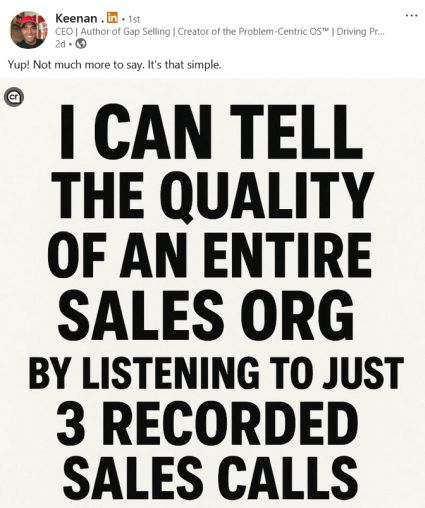
I made a comment, “Keenan, I’ll see you and raise you, I can tell the quality of the organization by sitting in on one team pipeline or forecast review 😁” Mark Hunter added, “David Brock Drop the mic and I agree with you David 100%….and we can tell the culture of the organization by listening to how management responds.” Alice Heiman added, “David Brock I’ll see you and raise you (I don’t play cards and I have no idea what I’m talking about on that front but) I can tell the quality of an organization by listening to how the CEO talks about them. And what you said and what Keenan . said”
What we were talking about is very different than how most would respond to the question, “How do you tell the quality of the sales organization?” Most people would pull out presentations of results. They would show charts on quota performance, YoY growth, big wins. They’d have me sit down looking at all sorts of performance charts on a screen.
To many, these are all you need to understand the performance of the organization. Just look at the data….
But what we miss is what creates those data points. We miss the work, the behaviors, the culture that underlies the data.
In listening to 3 recorded sales calls, you can tell a lot–not just about the individuals, but the organization. After all, they are just doing what they’ve been trained and coached to do. They may have rigid scripts and playbooks. They may not be listening, probing, understanding. They may not be curious, anxious to get to the pitch. If I see 3 people behaving similarly, it tells me everything I need to know about the organization. Are they peddlers, just focused on a PO or are they trying to build trusted relationships creating value with their customers in solving the customer problems?
Likewise, when I sit in a team pipeline/forecast review, I immediately understand the quality of the organization. Not by the numbers and the data presented, but by the discussion and interactions that surround the data. Are they creating excuses? Are they just managing to the numbers or trying to understand what created the numbers? Are they having discussions about what they need to change, what they might do differently? Are they exploring how they can constantly improve? Is it a collaborative discussion, or is the leader dictating what needs to be done?
And as Mark added, how management responds in these discussions is critical. Are they assigning blame or creating excuses? Or are they demonstrating accountability? Are they dictating the solutions or are they curious, recognizing each situation is different and helping their people figure things out. Are they modeling the behaviors they expect their people to be demonstrating.
And Alice’s view, “Let me hear about how the CEO talks about their people.” If all the CEO talks about is the results, the wins, the data; does that CEO really understand what’s happening in the organization? Does that CEO really care about the people in the organization and the work that gets done? If they don’t understand and care about the people that produce these results, the organization will struggle to achieve its potential.
While all the data and reports are interesting, we assess the quality and potential of the organization by the mindsets and behaviors that are displayed at all levels of the organization. Are people aligned? Are they engaged? Do they have a common purpose? Are they curious? Are the viciously customer focused (leaders remember your people are your customers)? Do they demonstrate accountability? Do they recognize the complexity and change that surrounds everything, experimenting and developing strategies to manage it? Do the have the discipline to do the whole job, not just the fun parts, but the tedious parts that are critical to getting the work done?
As Keenan, Mark, and Alice are saying, it’s incredibly easy to understand the mindsets and behaviors underlying the performance of any organization. Whether it’s listening to calls, sitting in reviews, hearing how management talks. Or wandering around the organization, sitting with them at lunch, participating in meetings. We see it in how they go about doing their work.
Mindsets and behaviors are the foundation for all performance.
Each of us is faced with a choice. We can adopt the mindsets and behaviors that drive high performance. Or we can be just “good enough.”
Afterword: In the next few weeks, my latest book, Is “Good Enough” Good Enough, Mindsets and Behaviors for Sales Excellence will hit the book shelves. I do a deep dive into the issues raised in this post. These are the foundations to sales excellence.
Afterword: Another fascinating AI created discussion of this post. My apologies to Keenan, they credit me with the key question he raised that drove this post. It’s an excellent discussion. Enjoy!

Love it! As an RVP at Gartner, ‘Renewals percentage’ was a big part of business success. I used to keep a metric on how many times the value delivered to the customer was mentioned in weekly sales briefings, and called it ‘CVG’ (Customer Value Generated). . It was really illuminating! When I started working with SaaS startups, I figured they would be equally focussed on retention as a driver of growth, so I’d use the same metric as an initial diagnostic. I had to stop, because customer value generated was NEVER mentioned by sales people. 😳.
Your sentence: “Mindsets and behaviors are the foundation for all performance.,” says it all! indeed we are in far more control of our results than we realize.