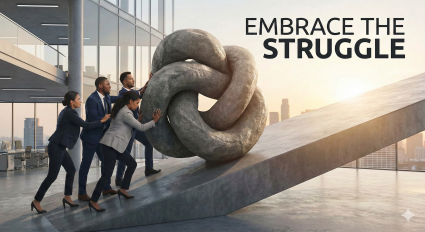
Ask any salesperson if they want to hit the President’s Club, make more money, and build a strong career they are proud of. Everyone will immediately respond, “Of course! I want to be the top performer!”
Nobody wants to be mediocre, but why do so many settle for it?
Stated differently, we settle for mediocrity not because we lack ambition, but because we want the reward without the risk. We want the outcome without the grind of doing the work that excellence demands.
Years ago, Mark Manson published a fascinating post, The Most Important Question Of Your Life. He suggests, rather than “What do you want out of life,” the most important question is, “What are you willing to struggle for?”
Mediocrity isn’t about the absence of wanting success. It’s about the unwillingness to embrace the struggle that creates success.
We see it every day. We look for the shortcuts, the hacks. We read about some guru who’s learned how to make millions, but we don’t see the work or behaviors critical in their own journey. We don’t see the years of their own struggles, adaptation, and persistence. Instead, we focus on the mechanisms they created to support their success.
People want the income of top performers, but they don’t want the rejection of rigorous prospecting. They want to drive their process without having to really understand who their customers are and what they are trying to achieve. They double down on their scripts and playbooks when things aren’t working, but they lack the curiosity to figure things out and change. They avoid the tedium of doing the detailed work, prepping for meetings, doing the research, leveraging the tools to help them make progress.
They want the win without doing the work.
They want the results, they don’t want the struggle.
I see the same patterns in sales leadership. Every leader wants their team to be the best. They covet the recognition and promotions. They want to build an organization that’s the envy of their competitors.
But are they willing to embrace the struggles that produce these outcomes?
Do they want to have the difficult conversations? Do they want the struggle involved in genuine coaching? Do they want to hold the line, maintaining high standards and refusing to accept or make excuses? Do they really care about the success and growth of everyone on their team? Do they want the struggle of modeling, every hour of every day, the behaviors that drive excellence?
Most don’t; they settle for looking busy while unconsciously pursuing mediocrity.
And in turn, their teams’ behaviors reflect the mediocrity their leaders settle for.
How do we achieve excellence? How do we perform to our full potential? How do we consistently outperform our competitors—who are doing the same things we are doing?
The answer isn’t wanting the results that excellence produces. Everyone wants those results.
The answer is, “What are you willing to struggle for?”
For sellers, it’s the basic mindsets and behaviors for excellence: genuine caring, constant learning/curiosity, deep customer centricity, full accountability, ability to deal with ambiguity/complexity, and the discipline of daily execution.
For leaders, it’s the same basic mindsets and behaviors. It’s having the difficult conversations. It’s having the patience and commitment to work with your people to help them achieve higher levels of performance. It’s about consistent standards, accountability, and a commitment to modeling these behaviors every day.
Achieving excellence is not about wanting it. It belongs to those who pursue excellence, who seek to learn and grow, and who embrace the struggle.
Some of you might be thinking, “That’s too much work.” For those who believe this, you’ve settled for mediocrity. Ironically, you’ve chosen the harder path. Mediocrity requires effort. You still have to show up, you still have to do the work (actually more). You still carry the weight of knowing you could do better. I’ve written about this before: Failure Is Harder Than Succeeding.
We have to stop asking ourselves, “What do we want,” rather we need to challenge ourselves with the question, “What am I willing to struggle for?”
Afterword: This is one of the better AI generated discussions I’ve listened to. Take the time to listen to this, their perspective is fascinating. Enjoy!

Leave a Reply