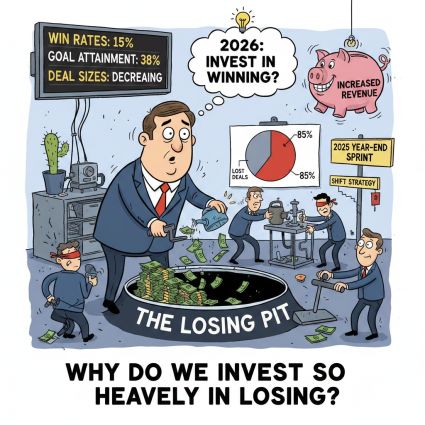
Yes, we are almost at 2025 year-end. I suspect many are rushing to close those last few deals, hopefully making the number. But as we start looking at the New Year, I wanted to pose a question, something to think about as you start looking to the New Year and chasing a new set of numbers.
Here it is, “Why do we invest so heavily in losing?”
Your reaction is probably, “Dave, you are crazy, we are investing money to win and grow our business, how can you possibly say we are investing in losing?”
I see budgets for the new year, heavily focused on generating more pipeline–whether in marketing or in sales. The budgets include heavy investments in technology, particularly AI tools to help improve efficiency and drive higher levels of outreach. And, yes, some organizations are hiring, though not at rates we’ve seen before.
Organizations are investing heavily in trying to hit their goals and scale their businesses.
But when one looks at the data, we see a different story. These organizations are investing heavily in losing.
Year over year, we see declining win rates. Win rates of 15-20% are considered the “norm,” everyone has those win rates. The percent of people achieving their goals continues to decline and is sub 40%. Deal sizes are going down, buying cycles are extending–so the automatic reaction is to do more.
To invest more in losing!
They aren’t consciously investing in losing, but this is, in fact, what is happening.
We accept 15% win rates, which means we are also investing in losing 85% of the time!
What if we asked ourselves the question, “What does it take to win more of that 85%?” We are already investing the time and resources into losing, what do we have to change to win more of that 85%?
Just imagine, if we can take our 15% win rates, increasing them by 50% to 22.5%. This drives a 50% increase in our revenue!
Stated differently, we don’t have a pipeline problem, we have a winning problem.
If we were to invest in winning rather than investing in losing, we would look at things differently. We would look, first, at how we increase our win rates. Then we would look at how we increase the quota performance of each person on our team (win rate improvements are a good start).
Some might respond to this, saying, “But we are hitting our numbers!”
Hitting the numbers is the easiest and most deceptive excuse. After all, that’s the key metric leaders and sellers pursue.
But the cost of hitting the numbers at 15-20% win rates and less than 40% hitting quota performance, is stunning. At the risk of repeating myself, we are investing money in losing, yet we use hitting the number as an excuse for this underperformance.
In maximizing our performance, we need to dig deeply into the numbers, understanding what they mean. What can we do to improve win rates with the money we are already spending? What can we do to improve individual performance, without having to invest more? What do we need to do to shift performance, on our current budgets?
It means breaking out of doing what we’ve always done, looking at how we learn, change, grow and improve. It’s how we get the maximum return out of every dollar invested, every hour we invest.
It requires each of us to be fully accountable for the results we create. It requires the daily discipline to do the work that drives success, not just the things we like doing.
Perhaps 2026 offers each of us the possibility of a reset. We are already spending the money, but rather than continuing to invest in losing, we must think, what do we have to change to win more of what we are already pursuing.
As we move into 2026, we start to think about the mindsets and behaviors that drive higher performance. What if we chose to invest in one change?
It all comes down to choice. What choice will you make for 2026!
All the best for an exciting New Year!
Afterword: Here is an outstanding AI generated discussion of this post. At the end, they get deeply into a discussion of the shifts we have to make to improve performance. Enjoy!

Leave a Reply