Look at most SaaS organizations today and you’ll hear the same language. Activities, velocity, scaling, predictable revenue. The underlying design has always been to build a selling factory; standardized inputs, consistent throughput, scalable output, predictable revenue.
Sales strategists and leaders cite Lean Manufacturing and the Toyota Production System as the inspiration. They talk about the principles, having only read the books, but not understanding what drove the success of Lean and TPS in manufacturing. They believed the selling/buying process was simply another assembly line.
Taiichi Ohno, Eiji Toyoda, and W. Edwards built something that turned traditional manufacturing processes upside down. Lean and TPS drove transformational improvements in manufacturing quality and efficiency. These principles remain the foundation of modern production systems worldwide.
What SaaS sales organizations built is not that. What they actually built was Taylorism. Frederick Winslow Taylor’s scientific management from 1911, the system that treated workers as interchangeable components in a deterministic process, where the job of management was to replace judgment with procedure and engineer the human out of the equation entirely.
Toyota spent decades exposing the flaws in that model.
SaaS sales spent years rebuilding this failed model, calling it innovation.
The confusion is understandable on the surface. Lean looks like standardization, metric tracking, and process documentation. Visible mechanics that are easy to copy. But underneath those mechanics are two foundational principles that SaaS missed entirely. And this meant the entire model was wrong from the start.
The first is variability. Toyota’s system was designed for a low-variability environment. Same metal, same tolerances, same parts, same sequence of manufacturing operations. The precondition for TPS to function is that variance can actually be reduced. The enemy of quality is deviation from a known standard, and that deviation can be measured and corrected.
In a manufacturing line, this is achievable. In selling, it doesn’t exist. Every buyer is different. Every organization has its own internal politics, budget cycle, and definition of value. Every conversation is a dynamic negotiation between two people with asymmetric information and competing interests.
Selling is a maximum-variance environment. Assuming this variance could be eliminated missed the reality of how customers worked and how they navigated their change process. Ignoring this reality, didn’t produce efficiency and better outcomes. It produced the illusion of process while destroying the adaptive judgment that is required in successfully engaging customers and creating value with them.
The second principle is more fundamental. TPS is a pull system. Production isn’t scheduled from the front end and pushed through. It’s triggered by real downstream demand and built backwards from the customer outcome. You don’t build inventory speculatively; you build what’s needed, when it’s needed, because the customer demand pulled it through the system. Ohno called this one of TPS’s two pillars.
SaaS inverted it completely. SaaS selling sequences were all push oriented. Activity was driven by internal needs, regardless of who the buyer was and where they were in their process. Cadences are schedules built around seller goals, not responses to buyer need. The entire engagement model runs in the wrong direction. They didn’t misapply Lean, a customer driven design. They inverted Lean to be a seller driven focus.
Everything that followed from those two foundational errors shows up in how SaaS sales organizations actually operate, and where they fail.
The organization and management runs on heroics. The leader who swoops in on every late-stage deals to win it, telling sellers “this is how I did it.” It feels productive, deals close, the manager believes they’re helping. But every time a manager solves a problem a seller should be solving, they confirm that the seller’s judgment doesn’t matter and doesn’t need to develop.
In Lean, the goal was never to solve the problem. It was to build problem-solvers. The people doing the work carried the primary responsibility for solving problems; managers were there to support them. Workers were trained in problem-solving, rewarded for surfacing root causes and preventing recurrence. The suggestion box in every Lean plant wasn’t a formality, it was a key part of their continuous improvement process. The workers whose ideas were implemented were recognized for it. Leaders understood that the people closest to the work had the deepest understanding of how to improve it.
Removing that responsibility from sellers doesn’t strengthen the organization. It reduces the capability of the organization to adapt and respond. And the consequences extend to customer engagement. If sellers aren’t measured on their ability to help customers solve problems, and have never developed that capability, they can’t create value in the conversation.
Buyers have drawn the obvious conclusion. They now prefer rep-free buying experiences, or they defer sales engagement to the very end of their process, the easiest part, product selection because that’s the only point where sellers can contribute.
The buyers have broken the code. Despite how much we say we help solve their problems, they know that sellers are not trained or rewarded for doing this, consequently, can’t help.
The KPI obsession follows the same logic. Thousands of AI-generated emails, scripted touchpoints, activity metrics tracked to the decimal. Metrics are necessary. But a busy plant floor and a high-functioning plant floor are not the same thing. A line running at full speed producing defective parts isn’t efficiency, it’s creating scrap. When the incentive is volume, sellers optimize for volume, producing the appearance of selling. The system was designed to focus on activity even if it wasn’t helpful to the buyer. As a result, buyers stop creating pull, and sellers had no idea to understand why things weren’t working.
The heroic closer culture is the natural result. The rep who saves a deal through a last-minute discount. The manager who forces the quarter closed through sheer pressure. These get celebrated. They shouldn’t be, they’re evidence of failure in the process.
There is no value creation. Organizations are plagued with poor pipeline quality and they don’t understand why. Discovery focused on seller objectives and never actually discovered what was most important to the customer.
Lean manufacturing didn’t celebrate fixing a broken machine. It asked why the machine broke and what would prevent it from breaking again. In selling, we do the opposite. We reward the crisis and never examine what created it, so the crises continue.
The management engagement model reinforces all of it. The playbook delivered from above, the script, the directive coaching session that focuses on compliance. People are told what to do, and deviation is treated as failure.
This destroys the organization’s ability to understand what’s actually happening in the field. The customer and seller relationship becomes an abstraction on a dashboard. Lean manufacturing required managers to walk the floor, ask questions, and learn from the people doing the work. The ideas for improvement came from the shop floor, not the conference room.
Modern sales organizations have removed leaders, operations, and enablement from any genuine contact with the reality of the work.
Then there’s the gap between documented process and actual workflow. CRM updated in the last week of the quarter, if at all, and only to keep managers off their backs. Methodologies that consume millions and go unused. Tools, technology, programs, and now AI are noy adopted because none of it was built around the reality of what sellers actually need to do.
In Lean, the standard is defined by its usefulness to the person doing the job. If it isn’t useful, it’s waste, and it gets eliminated. That discipline never made it into SaaS sales.
And then there’s alignment, more precisely, the absence of it. Leaders agree the organization needs to focus on pipeline quality and disciplined execution. This gets announced at the SKO, reinforced at the all-hands, met with nods all around. Yet, nothing changes. The compensation plan still pays on volume. The pipeline metrics still reward quantity over quality. The systems still make it easier to fill the funnel with garbage than to disqualify a bad opportunity early. When incentives, systems, and stated strategy point in different directions, people do what they are paid to do.
None of this is what Toyota built.
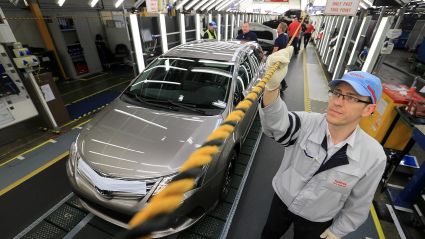
What Toyota actually built was a system that recognized the person doing the work as the critical element, not a replaceable widget, not a variable to be controlled, but the primary source of quality, adaptation, and improvement. The Andon cord, which gives any worker the authority to stop the entire production line when they see a defect is a design principle.
The person closest to the work has the authority to stop the line when they see something wrong. And in correcting the situation, it’s those people that have the most critical information needed to solve the problem. The system is only as good as its ability to surface and act on that information in real time. That’s the pull principle applied to quality: a problem triggers a response, and the response is driven by the people doing the work and it is immediate.
SaaS sales built the opposite. It automated the human touchpoint on the assumption that human judgment was the bottleneck. It believed that scale required eliminating variance, removing genuine conversation, and replacing adaptive thinking with compliant execution.
What it produced wasn’t sustainable performance. It was scale applied to mediocrity. The variability didn’t go away. Buyers are still different from each other, still operating in dynamic contexts, still making decisions on the basis of trust, relevance, and the quality of a conversation.
But the SaaSification of selling, ignored this, ensuring that when the approach failed, it failed at volume, no ability to understand why.
We can learn from Lean and TPS. The principles that made them so powerful were centered entirely on the people doing the work; their intelligence, their judgment, their capacity to adapt and improve. It was based on trust in those people, providing them all the resources they needed to perform at the highest levels.
The people who introduced these ideas into SaaS never understood that. They saw an assembly line, and that’s what they built. The question now is whether we’re willing to understand what we actually got wrong or whether we’ll keep going through the motions and wonder why the machine doesn’t run.
Afterword: Here is the AI generated discussion of this post. As has become more common, they take some fascinating twists in the conversation. Enjoy!

Great read. The metrics obsession, totally at odds with anything that delivers value to customer or for the company, is such a great indicator. It’s a hallmark of ‘manage what you can manage’ rather than leading anything meaningful.