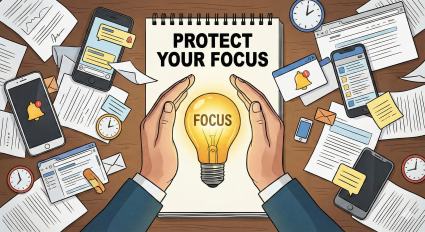
Tobia La Marca said something fascinating a few weeks ago (he says a lot of fascinating things). A sentence stood out: “Protect Your Focus.”
It’s particularly ironic that at this moment, I’m jumping between writing this article, looking at an email that just arrived, thinking about a meeting in an hour, and seeing alerts creeping up on LinkedIn.
We all suffer from this inability to focus. Our devices and apps create massive distractions. And our own minds cause us to drift from topic to topic.
In these distractions, we feel as though we are accomplishing things. We clear our emails as they arrive. We keep updating social media, responding, InMails/invites, commenting/liking for visibility. We tick through each meeting on our calendar robotically.
Dealing with and managing all of these gives us a sense of accomplishment, while what we are actually doing is going through the motions.
We are all crazy busy, but that busyness is just an illusion.
Being busy is not the same as being effective. Making calls is not the same as creating value. Attending meetings is not the same as driving outcomes.
We’ve confused activity with achievement, motion with progress.
When we let interruptions fragment our attention, we’re not working, we’re responding. We’re reacting to whatever demands attention in the moment rather than proactively focusing on what matters most.
All of this activity and responsiveness feels productive. We can point to how busy we are as evidence of effort. We can look at our loaded calendars, proud of being busy. But something’s missing.
Most of us operate in perpetual react-respond mode. Something comes in, we deal with it. Another thing comes in, we deal with that. We’re like pinballs, bouncing from one demand to the next, our focus, or lack of focus, determined entirely by whatever hits us.
And those carefully constructed blocks of time we put in our calendars are destroyed.
What we fail to consider in react-respond mode is: What’s most important and impactful right now?
We let urgency override importance. The loudest demand gets our attention. The most recent email jumps to the top of the queue. The person that shoots us a text message diverts us from the work we’d planned.
We end each day exhausted, having responded to dozens of demands, yet wondering why nothing meaningful got accomplished. The important work: the thinking, the planning, the work on critical projects, coaching and developing our people—keeps getting pushed to later. And ultimately may not get done.
“Shit I Have to Stop!”
One of the most powerful workshops I conduct is called, “Shit I Have to Stop!”
This is the opposite of how most of us operate. Before you can protect your focus, you have to decide what to stop doing.
We tend to work in “pile-on” mode. New priorities get added. New initiatives get launched. New responsibilities accumulate. But nothing ever comes off the list. We just keep adding, until we’re buried under more commitments than any human could possibly honor.
The discipline of focus isn’t just about what you choose to do. It’s about what you choose to stop doing.
What meetings should you stop attending? What reports should you stop creating? What activities have become habit but no longer create value? What “responsibilities” have you accumulated that shouldn’t be yours?
Don’t add anything new until you’ve first stopped something else. This simple rule transforms how you think about commitments and what you get done.
The most focused people I know are ruthless about stopping. They regularly audit their activities and ask: “Is this still worth my attention? Does this still create value? Should I still be the one doing this?”
It’s not just about saying “No.” It’s constantly focusing on what’s most important. It may mean saying “No” to many of the things you have always done; adventuring into experimenting, changing, and doing things that have greater impact.
The Organizational Focus Problem
It’s not just individuals who struggle with focus. Organizations fragment attention systematically, ususally without realizing it.
What causes this? Poorly defined roles, responsibilities, and workflows.
When accountability is unclear, three things happen:
First, people end up doing work that others should be doing. You step in because it needs to get done and no one seems to be doing it. Before long, you’ve accumulated responsibilities that were never meant to be yours, reducing the attention on those things that are your responsibility.
Second, redundant work multiplies. Without clarity about who owns what, multiple people tackle the same problem. Two people prepare the same analysis, without knowing the other is duplicating what they are doing. Teams do redundant work. Different people build conflicting plans to address the same issue. Resources are wasted. Confusion and conflict set in.
Third, important things fall through the cracks. When everyone assumes someone else is handling it, no one handles it. The lack of clear accountability creates gaps. Then we move into crisis mode when those gaps become visible.
All three of these are focus destroyers. They pull people away from their jobs, their highest-value contributions, scattering attention across activities they should not be doing.
If you lead an organization, ask yourself: How much of your team’s fragmented focus is caused by unclear roels, responsibilities, and workflows? How much time is wasted because people don’t know who owns what?
Clarifying roles and responsibilities isn’t just about organizational efficiency. It’s about focusing everyone on the things that matter most.
Focus Is a Choice
Protecting your focus requires deliberate choice. It means choosing what not to pay attention to, choosing what to stop, being disciplined in where, what, and how you invest your time.
We live in a world of distraction. Every notification, every social media alert, every text message, unexpected phone call, each of our devices, every window we have open on our computers. Each gives you a choice. Every piece of work you do that someone else should own is a choice to neglect your real priorities. You can react-respond, abandoning what you prioritized or wanted to focus on. Or you can exercise discipline in focusing on what’s important.
And there is a multiplying effect to these choices.
Just one data point show how brutal this can be: Studies suggest it takes 23 minutes to fully refocus after an interruption. If you’re interrupted just four times in a morning, you’ve lost over 90 minutes your productive capacity. This is not due to the interruptions, but to the recovery time. And if those interruptions were on matters that weren’t that important…….
Discipline Trumps Motivation
You cannot protect your focus through willpower alone. With all that we have coming at us, our willpower wears down. And in the end, it is exhausted and we revert to react-respond.
Focus requires discipline, systems, habits, and accountability.
What does this look like practically?
- Defined focus blocks: Time that is protected, where devices go silent and email stays closed. Not because you feel like focusing, but because it’s 8:00 AM and that’s what you do at 8:00 AM.
- Batching distractions: Checking email at scheduled times rather than as each message arrives. Clearing social media in defined windows rather than continuously.
- Regular “shit I have to stop” audits: Weekly or monthly reviews of your activities, asking what should come off your plate. What have you accumulated that no longer serves your highest contribution? Should someone else be doing this?
- Clarity conversations: If you’re doing work that should belong to someone else, have the conversation. Clarify accountability. Push back on scope creep. Protect your focus by ensuring you’re focused on the right things.
What Are You Protecting Your Focus For?
But discipline alone isn’t enough. You also need to know why you’re protecting your focus.
If you’re protecting focus just to be more productive, you’ll eventually ask: “More productive at what?” And if you don’t have a compelling answer, the distractions will win.
Purpose fuels discipline. When you’re clear about what you’re trying to create, what difference you’re trying to make; protecting your focus becomes less about restriction and more about committing to do the things that really matter.
I try to protect my focus because the work I do when truly focused enables me to achieve so much more. For my clients. For my colleagues. For my organization. For myself. That focused work is where I create real value.
What are you protecting your focus for?
A Small Experiment
Try this for the next 4 weeks.
One hour per day of protected focus. No email, no notifications, no interruptions. Dedicated to the single most important thing I need to accomplish. It may be writing. It may be working on a client project. It may be developing new offerings.
And one “stop doing” decision. Something I’ve been doing that I will deliberately stop, freeing up time to focus on what really matters. It doesn’t have to be complicated. Just something I’m doing because I’ve always done it, but it may not be important anymore.
Focus requires discipline and purpose. It requires us to be accountable.
Tobia was right. Our focus needs protecting. Because if we don’t protect it, no one else will.
Afterword: We are helping our clients recover their focus and priorities with our “Shit we have to stop” workshops. If you are curious and want to look at a workshop for your team, email me at dabrock@email.com
Afterword: This is the AI based discussion of my post Protect Your Focus. As usual, they take some fascinating twists and turns in the discussion. Enjoy!

Leave a Reply