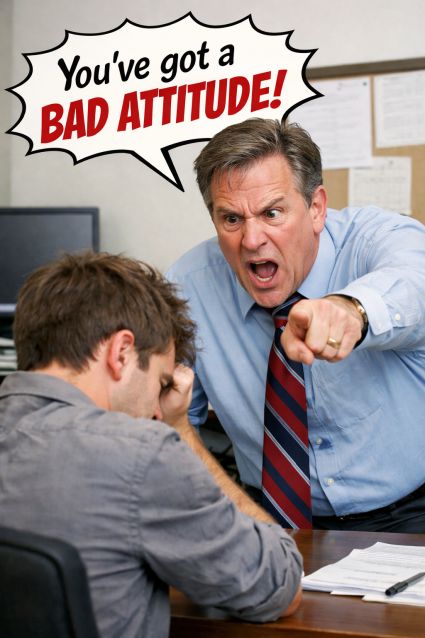
“Attitude” is one of the most confidently used, yet least defined words in our vocabularies. We hire for attitude, we fire for it. “Jill’s got the right attitude!” “What’s it with Ned and his bad attitude?”
Attitude permeates our language, training, and performance discussions, but when we use it, what are we talking about? When we use the word attitude, what do we mean? What’s the definition of the word? And if we understand that, can we actually do anything about attitudes?
When someone has the “right attitude,” what does that mean?
What we are really observing is their behaviors. How they engage customers, how they manage their week, how they respond when things go wrong.
We use the word Attitude as a label for a pattern of behaviors that we see.
But the problem is, what does someone do when they are told they have a good or bad attitude? What does it mean, what do they have to change, how do they make the change? It’s impossible for anyone to act on that statement.
This is why we have to stop talking about attitude. It’s a catch-all for all sorts of behaviors. To drive change and create a “better attitude,” we have to focus on their mindsets and behaviors.
Mindsets drive behaviors. Behaviors reveal Attitude.
Mindsets are the beliefs, assumptions, mental models that shape how we interpret everything going on around us. They might include: Believing our job is to create value with our customers. Knowing that disciplined execution is critical to our success. Recognizing we are accountable for the outcomes we create.
Behaviors are the observable actions, the execution, that flows from these mindsets. If we believe our job is to create value with our customers, the behaviors that dominate are deep customer centricity, curiosity, and comfort with change/complexity. We demonstrate disciplined execution in how we manage our time during the week, how we prepare for meetings, how we show up every day at work. Demonstrating accountability means you don’t blame a loss on bad product, price, or any other excuse. We recognize that others might have better products or lower prices, and we develop strategies that make those less important in the decision-making process.
When we make this shift to focusing on mindsets and behaviors, we now have something that’s observable, measurable, and most importantly coachable. I don’t know how to coach attitude. I do know how to coach customer centricity, discipline, and accountability. And the person I am coaching understands the focus and how they might improve their performance.
We need to banish the word “attitude” from our conversations. It doesn’t mean anything. It is judgmental yet provides no understanding of the judgments made.
The next time you are tempted to call someone out on their attitude, think about what would be more useful. Rather than saying, “Dean, you’ve got the wrong attitude in doing the job.” you might say, “Dean, if you improved your discipline, you’ll get huge improvements in how you manage your work week. Let’s talk about what this means and how you might improve your discipline.”
We drive improvement, development, and learning when we get specific. When we focus on coaching the specific mindsets and behaviors, we focus on what we see, how it impacts performance, and how we might drive performance.
Afterword: An outstanding AI generated discussion of this post. Enjoy!

Behaviors reveal Attitude. True.
And,
Attitude leads to Behaviours.
The great thing is that ATTITUDE is a choice.
Choose wisely.
Thanks Dave great Topic.
I wrote a Sales Attitude ‘test’ about 13 years ago,
it still holds up….
https://brianmaciver.blogspot.com/2012/11/managing-sales-attitude-for-success.html
Outstanding article Brian. Thank for sharing.