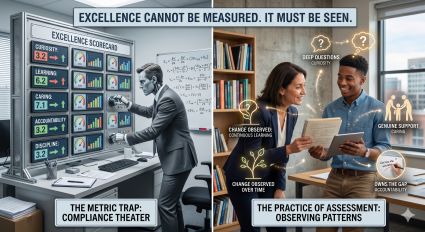
Every leader who takes the behaviors of excellence seriously eventually asks: how do we measure them? How do we score curiosity, continuous learning, caring, customer centricity, the ability to deal with change and ambiguity, accountability, discipline, purpose? How do we turn these into something we can track and manage?
The question, itself, is the problem.
The moment you try to score these behaviors, they collapse. People perform to the metric, the metric becomes the goal, and the behavior, itself, is lost.
This is the activity-metric trap we’ve already injected into our sales processes, our pipeline reviews, our coaching programs, and every other mechanism we develop. And now we want to inject it into these behaviors.
And, the result will be the same. We will get compliance theater instead of real behavioral changes. We will see fascinating scorecards, but none of the outcomes we would expect.
But “we can’t measure it” is not the same as “we can’t assess it.” That distinction is critical. By the way, this distinction is as important for our mechanisms as it is for our behaviors.
These behaviors are not abstract traits somewhere inside a person. They are observable patterns, and we observe them in the work every day, if you are close enough to see them.
Curiosity shows up in the questions people ask. The depth of their discovery. The willingness to go past the first answer. The pursuit of understanding before jumping to a solution. We see it in how differently someone approaches their tenth deal compared to their first, because a curious person is learning and a compliant person is executing a template. It shows up in whether people come to one-on-ones with questions or just with status.
Continuous learning is what curiosity becomes over time. It’s how they grow in their role, in whether this year’s version of them is better than last year’s. You see it in the books read, the conversations sought out, the deliberate exploration of ideas not related to their current job.
You also see its absence, in people who have ten years of experience that is really one year repeated ten times. The clue is whether someone is still changing. The tenured person who asks the same questions, makes the same arguments, and uses the same playbook they used five years ago has stopped learning, regardless of how many training programs they have attended.
Caring shows up in what people notice. Whether they see the customer as a source of revenue/commission or a person/organization to serve. Whether they remember what the customer said about what mattered to them. Whether they push back when something isn’t right for the buyer, even when the process says to move forward. We see it in how they treat their peers and others in the organization. Most importantly, we see in how they think about themselves and their continued growth. People who care demonstrate it in every interaction, and people who don’t, don’t.
Customer centricity shows up in how the customers are engaged. It shows up in the language people use, the questions they ask, the tradeoffs they make, how they view what the customer is trying to achieve. And it shows up in how they reflect those things in internal conversations. You can see it in a deal review in about two minutes, if you know what to listen for.
The ability to deal with change and ambiguity shows up in what people do when the situation doesn’t match the plan. Do they freeze, looking for a rule? Do they escalate, looking for permission? Or do they engage, trying to make sense of the new reality, seeking to figure things out, and moving forward with appropriate risk? This isn’t a score. It’s a pattern that repeats across every ambiguous moment of someone’s work.
Accountability shows up in the gap between commitments and actuals. In how losses get processed, with ownership or with blame. In whether bad news surfaces early or late. In what people do when they realize they’re off track, whether they raise their hand or wait to be caught. It shows up in the quality of post-mortems, assuming we do them.
Discipline shows up in the cadence of work, the follow-through on the unglamorous parts, the refusal to skip the steps that don’t feel urgent. It’s visible in how people manage their time, their preparation, their commitments to themselves, their customers, and their organizations.
Purpose is the hardest to observe from outside, but it shows up in energy and direction. In whether people bring their own agenda to their work or wait to be assigned one. In what they do when no one is watching. In the projects they volunteer for and the ones they quietly let die.
None of this is a number. They won’t show up on a dashboard. All of it is observable. And that’s where the measurement problem reveals itself as something else, a proximity problem.
If a manager can’t assess whether someone on their team is genuinely curious, genuinely accountable or caring, it’s because they aren’t displaying those behaviors themselves. If all they’re focused on is the CRM, the dashboards, the numbers. If they fail to recognize the importance of the behaviors, they will fail in their ability to observe and assess the behaviors.
The demand for a measurement system is more often a demand for a way to assess behaviors without actually having to observe them. And a laziness in exercising those behaviors themselves. And this doesn’t work.
Why do we keep reaching for metrics when the behaviors are so visible in how people are doing the work?
Assessment requires personal demonstration of the behaviors themselves. If we don’t care, if we aren’t curious, if we aren’t disciplined and accountable, we will never recognize those behaviors in others. Being able to assess these requires trust in the assessor, and we have spent decades stripping trust out of our management systems. Pursuit of a scorecard becomes a surrogate when trust is absent. Managers are asked to produce numbers because their managers don’t trust their observations.
Afterword: This AI generated discussion is actually far more clear and striking than the post. Please take the time to listen to this outstanding discussion. Enjoy!

