This is the second in my organizational design series. Reading the title, I’m sure you are thinking, “Dave, you’ve gone off the rails. We know what the work is!! Why are you wasting our time writing about it?”
As I discussed in the previous article, we allow our existing organizational structures to determine how we define the work. But is this the right way to think about it.
Take a moment to think about the work. How would you describe the “work?” How would someone in an adjacent function describe the “work?” How would a customer describe it?
You will get at least three different answers. Even though we “work” with each other, the way each of us describes the work is very different.
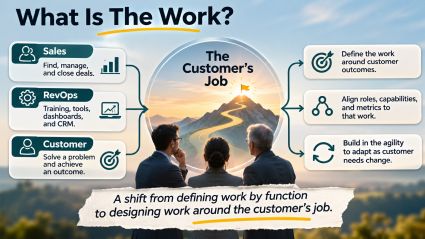
If you are in sales, your work revolves around finding, managing, and closing deals. The sales process, pipeline, and CRM are all parts of what we do. We measure our work on activity, pipeline, and quota attainment metrics.
A person in an adjacent function, let’s say RevOps, will describe their work differently. New training, new tools, new dashboards/reports. Their metrics look at number of people trained, tech stack, CRM compliance, and others.
And the customer would describe their work differently. They are focusing on the problem they are trying to solve and the outcome they seek to achieve.
In this simple example, we see three functions seeking to work with each other describing the work very differently. It’s this gap that causes the misalignment in the work, yet these functions are dependent on each other for success. Not only does this create conflict, but it means each function defines success differently.
And this can be multiplied across functions within the organization.
Now we can begin to see the challenge all of us face.
We need to work with each other, yet the way we have designed the work creates conflicts.
Since our success is based on acquiring and retaining customers, it seems we should design our work in a way that supports what the customer is trying to achieve, builds trust, and encourages them to continue to do business with us.
Obviously, we can’t design unique approaches for each customer, but we could design the work around our Ideal Customer Profiles.
This would require us to look at things from an outside-in perspective, rather than an inside-out perspective. But it’s a little more complicated than this.
We design our ICP around identifying customers who have the problems we solve. This is an inside-out choice. Our strategies focus on solving certain types of problems; whether it is a software solution focusing on CRM, or a hardware product that does certain functions, or a set of services that revolve around a problem.
Who we serve is an inside-out choice.
But now we have to look at how we work with them. This has to be an outside-in design. We work backwards from “how do they recognize the problem, how do they make a decision to change, how do they organize to solve that problem….”
The way we work with them must be designed around helping them recognize and solve the problem. This doesn’t mean we design different workflows for each customer. We have the experience of working with 100s-1000s of customers. We learn from how they work, designing workflows backward into the organization. And we design these to be adaptable, at least for those working directly with the customer.
How do we do this?
We have lots of lessons from the past. Approaches in Lean Manufacturing/TPS and Jobs To Be Done (JTBD) are just a couple.
The fundamental principle in Lean/TPS is “the next process is the customer,” with the value defined from the end customer. The work at each step is designed to serve the “customer.” In this process, we start with the end customer, working backwards. Each step is optimized to serve the step it supports. Goals and metrics are aligned around this workflow.
Where Lean/TPS helps us better understand and design the workflow that creates most value, Jobs To Be Done helps us to understand what the customer is trying to accomplish and why.
The customer’s job isn’t to buy our solutions. It is to perform the work that creates the outcomes important to them, their roles, and their organizations.
Jobs To Be Done, JTBD, starts with the customer’s job. It focuses on understanding this, translating to the job our solutions do to support the customer’s job.
Perhaps the best way to illustrate this is to use Clayton Christensen’s “milkshake” example.
In this a fast food chain wanted to drive milkshake sales. They approached it by surveying customers about how to create a better milkshake, flavors, thicknesses, and other factors. Despite the research and the new milkshakes they delivered, sales weren’t changing.
Christensen’s team looked at it differently. They looked at it from the point of view of “What do the customers expect the milkshake to do for them?” In their research, they discovered many milkshakes were sold in the morning commute.
What commuters wanted was something that would make the commute less boring, that they could hold in one hand, that would last through the commute, that wouldn’t mess up their cars. They were competing against bananas, bagels, donuts and other things.
They discovered bananas were eaten too quickly and there was the problem of what one does with the banana peel. Bagels were messy and required two hands to put on the spread. Donuts weren’t satisfying. Milkshakes were much easier for the commute.
Afternoon milkshake sales were different. Milkshakes were often bought as treats for kids to keep them happy.
His team discovered the milkshake had two jobs, making the morning commute less boring and creating treats for children.
What we take away from this is that the customer’s job is not defined by the product we sell. The customer wasn’t buying a milkshake because they liked milkshakes, they were buying something that could make their commute more enjoyable.
As we look at this in our GTM applications, customers don’t necessarily seek to buy CRM. They may be looking for better ways to communicate what’s happening with their customers across the organization. They may be looking at how they could improve information flow within the organization. They may be looking at how to acquire, develop, and retain customers.
CRM is a tool that helps them perform those jobs. If we change our approach from selling CRM, to looking at how CRM helps them do their jobs, we connect in a way that creates more meaning and value to the customer.
So what does all this mean in terms of how we design our work in ways that create the greatest value for the organization?
First it means understanding the work that needs to be done by the people/orgs that we seek to help. What are the capabilities they need to do that work? How do we help them develop the capabilities?
In this, we might start thinking:
The AE’s purpose is to create value through helping the customers better understand the job they need to do. In this they help the customer recognize, understand and address challenges they face in doing it. They demonstrate how our solution provides them the capabilities to more effectively address those challenges and do their jobs. As importantly, the job of the AE is to help reduce the fear customers have in making a change by building their confidence they are doing the right thing for them and their organization.
In turn, SDR/BDRs must understand what the AE faces in doing their jobs. Just like the milkshake story, SDR/BDRs need to know what AEs are hiring them to do. AEs don’t need more meetings on their calendars. The AE must spend their time working with customers who are experiencing the problems our company solves. They can’t be wasting their time on customers that don’t have those problems or may not need the help now.
So we redesign the job of the SDR/BDR to provide the AE the right work/opportunities they should be pursuing. This goes beyond getting a meeting to getting the right meeting with the right people at the right time. And we change the metrics from number of meetings and outreaches to meetings that serve what the AE needs. Critical in this, and a lesson from Lean, is that AEs must be engaged with SDR/BDRs helping them understand what the right meeting looks like.
And we can see how this ripples back into Marketing. Marketing’s job shifts from providing outreach, leads, and MQLs that SDR/BDRs have to sort through. Instead, it’s targeting the organizations and people that are most likely to want to have a conversation with the SDR/BDR. But here, we can also learn that Marketing doesn’t just have one job, there are multiple jobs to be done, each serving different purposes. How does marketing best serve the organization? How does marketing best serve the customers in helping them better understand what they might face and how they might chang?
RevOps/Enablement’s job now becomes providing SDRs/BDRs, AEs, and customers the capabilities, systems, and tools to most effectively do their jobs.
And we can see this ripple through the entire organization, the metrics and goals that are set, and the leadership/coaching managers must provide to reinforce this. We aren’t redesigning individual jobs, we are redesigning those jobs and how they connect.
This article is about the work and how we design it to more impactfully achieve our goals. It’s a departure from the way we seem to design our organizations and their work by defining and rearranging blocks on the org chart. It’s also a departure from the classic approaches which tend to be inside-out, rather than outside-in.
But a cautionary note about how we define the work and design our organizations to support it. Work, particularly in GTM, is constantly changing. We must design agility and nimbleness into our work.
Part is recognizing the constraints or guardrails we put in place, letting individuals adapt to the specific situation they face. Part is recognizing the turbulence that exists in our business worlds, recognizing our customers and our organizations are constantly adapting and our definition of the work has to reinforce and support that adaptation.
Perhaps the most important question isn’t whether we’ve designed our organizations efficiently, but whether we have designed them around the right work. Each organization can be outstanding in their execution and achieving goals, but they fail to work together in creating the value customers need. Until we rethink the work itself, rearranging our org charts won’t accomplish much.
In the next article, we will dive more deeply into the concept of “not all the work is the same.” And in a future article, in this series will be about the impact of AI. It is, perhaps, one of the biggest changes in impacting the work both we and our customers do. We can’t talk about organizational design without spending time on the impact of AI.
Afterword: I’m constantly amazed with these AI generated discussions. They always manage to take the ideas in my posts and present them in much simpler ways. Their discussion of applying Lean/TPS and Jobs To Be Done is stunning! Enjoy!

