I used to think fine dining meant which dipping sauce I chose for my French fries. Then I met my wife. Kookie had an amazing palate and talent with food. First, she introduced me to NYC restaurants like Le Bernardin, Lutèce, Le Cirque, and later, Chez Panisse in Berkeley.
She had gotten to know many of the Chefs, so often, we’d get the last table of the evening, then spend time drinking and talking food with the Chefs. To me, it was a foreign language.
Later, she left a great career in technology sales/leadership and enrolled in the CIA (Culinary Institute of America). She took the three year program to pursue her dream of becoming a Chef.
Often, I became the guinea pig on her homework assignments.
I remember her very first course was on knives and cutting. I thought it was a little weird to have a full 3 week course dedicated to this. When I prepared food at home, I just chopped things up.
But Kookie would come home to practice. Her victim was a harmless potato. Again, my experience was to chop it in half, maybe quarters. Sometimes, I’d try slices for fries.
But Kookie started talking about all sorts of different cuts, Brunoise, Paysanne, Rondelle, and dozens of others.
Each was very different. Each had a different purpose. Depending on the dish Kookie was preparing, the flavor she was trying to create, different cuts were required.
And that was just for potatoes.
As she went through the program, I could see cooking was much more than opening a can of chopped tomatoes, tossing in some garlic, salt, pepper, and creating spaghetti sauce.
I learned that for Chefs, cooking isn’t creating something that tastes good. It’s creating an experience that begins with being presented the dish. Then it develops with each bite.
It’s a unique combination of at least a dozen things, including flavor, aroma, texture, presentation, emotion, and story.
Experienced Chefs take the very same ingredients, creating very different dining experiences. This fact has driven dozens of cooking shows and competitions for years.
Part of what I saw professional Chefs doing was to leverage the very best in cooking technologies. Machines could do much of the chopping. Blenders created a much smoother result in far less time. Mixers were much more efficient than manual mixing. Sous-vide could maintain a certain cooking temperature better than any human using a stove.
These tools did phenomenal things in improving the productivity and efficiencies of Chefs in the kitchen. But they were never the differentiators. Every kitchen and every Chef had access to the same tools.
What the tools could never do was create a fine dining experience.
I tried an experiment. I happen to know a relatively famous Chef. His restaurant and food are widely known. They have been awarded some Michelin stars.
Before calling him, I decided to do a compare/contrast experiment. I started by going to ChatGPT. I wanted to compare what it gave me to the conversation with the Chef.
With ChatGPT, I said, “I’m throwing a party, I want to prepare Chef So and So’s very famous recipe for (This).
It was amazing. It told me the type of potatoes I needed to buy, the vegetables, and the meat. It told me what to look for in buying those ingredients.
It went through telling me to cut the potatoes in a Brunoise and why it was important.
It walked me step by step, not only telling me how to mix the ingredients, but why I needed to do it that way.
In the end, I could reproduce the recipe.
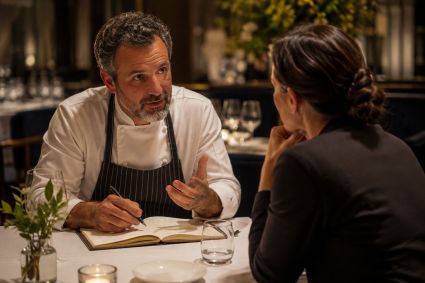
After that, I called the Chef. I said, “I’m having a party, I know I can’t reproduce this dish the way you can, but can you get me close?”
The first thing he asked me, “Who will be eating it? What are their tastes, when and where will you be serving it? What equipment do you have?” He went through a dozen questions, then finished with, “How experienced are you?”
We had an entire discussion about the experience I was trying to create and my ability to create that experience. Only after that, he told me, “Here’s what I would do…..”
The difference was profound. I didn’t create what he could create, but I was able to present the finished dish that made everyone’s experience memorable.
ChatGPT answered the question I asked. It took great care to make sure I understood the rationale underlying its instructions.
The Chef wanted to understand what I wanted to do, the experience I wanted to create, my ability to do it. What he was really doing was understanding the question I was really asking which was to create a memorable experience for my guests.
You probably are thinking, “Dave, this is a nice story, I’ll remember it next time I visit Taco Bell. But what’s this mean to what I do, complex B2B selling?”
How do we build on what we see Chefs doing?
When I look at my own career, I see many parallels.
Before I could call on CEOs and top execs to drive $billion plus deals, I had to first learn to “cut potatoes.” Hundreds of meetings, with all sorts of people. IT analysts, data center managers, data entry clerks, end users, end user managers, CIOs, CFOs.
I had to learn how to blend their different tastes, appetites for change and risk, how to pull them together in defining a solution. They could, maybe, describe, “I want ranch dressing for my fries,” but I could help them think differently imagining something new.
I learned that while each CRO asked me, “How do I drive faster growth,” the answer only came after long conversations. And each answer was different.
As part of that growth process, I had managers constantly challenging me with the same question my Chef friend asked, “How experienced are you?” Like the Chef, their coaching was influenced by my answer to that question, not what they wanted my answer to be.
It took years of trial and error.
Along the way, I was one of the first to leverage technologies to help me get better faster. I sought technologies that could do things better than I could, and technologies that could help me think differently. How I use AI every day is focused on just that.
There are many parallels between high impact B2B sales and leadership and the professional kitchen.
Both require years of doing the work to build the judgment, experience, and discernment.
In both, much of the work is mundane, unimaginative, but foundational. We can’t skip it because it is how we build these capabilities. There are no short cuts.
For both, tools and technologies are critical, not just in improving efficiency, but in helping us think differently. But the answers they give us are not the answers our customers need.
And finally, anyone can give you the “recipe,” or the solution. The solutions our customers need are a result of the conversations we have. Our work is to help them to understand what they are trying to create. And once they make the decision, working with them to help them get there.
The same conversation my Chef friend had in helping me plan my dinner.
Afterword: There are a few errors in this fascinating AI based discussion of this post. The biggest was how they pronounced Kookie’s name—a pronunciation I tried once and she quickly “taught” me the errors of my ways. In spite of that, it’s a great discussion. Enjoy!

