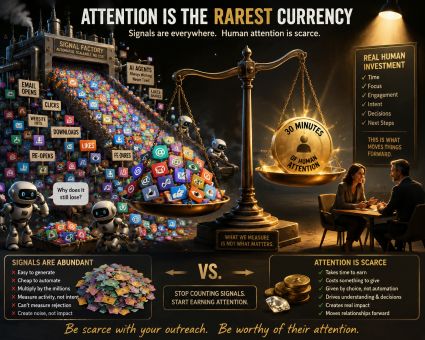
Leveraging buyer signals has become a fascinating topic in trying to understand buyer intent. Where before we relied on people responding to an email, accepting a meeting invitation, inviting others to the meeting as being signals indicating interest and, sometimes, intent.
Now we can monitor tens of thousands of signals. We can look at every outreach across every channel to people in an organization. We can monitor opens, forwards, re-opens. We can monitor downloads and shares. We can look at every website hit. We can look at the complete past history of all of these.
Taken individually, they may not mean a whole lot. But the current generation of tools can aggregate thousands over time and begin to get some richer understanding of buyer intent.
However, what is valuable about the signals isn’t the signal itself. What is valuable is the indicator that someone invested time and attention. The evidence that someone chose to stop, and invest themselves in something that was a signal to us.
Even if only for a fraction of a second it was the investment of attention. And we can see some investments are greater than others.
Opening an email is a pretty minimal investment. Responding or forwarding it is a bigger investment. Opening a webpage doesn’t take a lot of time, but if it is opened repeatedly, more time is invested.
Liking a post on LI is an investment in a fraction of a second of time, commenting is more and sharing indicates more.
Sitting in on a meeting and agreeing on next steps, possibly one of the most powerful signals showing the investment or their attention.
As we aggregate and analyze these signals, our tendency is to focus on the signals themselves, not the investment in attention. 1000 opens become more meaningful than one meeting, even though at 0.5 seconds per open, the total time invested across all recipients was only 8.3 minutes, where a meeting might represent 30 minutes for each participant.
Imagine, sitting down with 4 people for that 30 minutes, capturing their attention. Collectively 4 hours rather than the 8.3 minutes. But what we and they learn in that 30 minute investment/person is so much more!
We lose this understanding of attention in our signals, instead we see 1000 opens and 4 meetings, focusing on the bigger number.
The problem is getting worse. Signals are, disconnected from buyers’ investments in time and attention.
Today’s technology massages these thousands of signals providing insights and reports on everything but the most important, time and attention.
Now overlay this with a more important challenge. It’s the AI agents buyers are putting in place. Agents now intervene on all our emails, manage social media interactions, even phone outreaches. Buyer agents crawl the web, looking for information, consolidating thousands of inputs. All of these show up to us as signals.
Yet they no longer carry the impact signals had. They are no longer measuring the investment in time or attention.
We no longer know if the agent alerted the human about the emails or outreach, or just filed it away. We no longer know if the social media interaction was because a person invested time to interact, rather than an agent choosing to interact. We no longer know if the website hits are ever presented to the individual, or if the results were filed away.
Yet we revel in measuring these signals.
Our signals only measure the artifacts of engagement, but they can’t measure rejection. We know the hundreds of times an agent hit on our websites. We never know if they used the information at all. We never know if a human had any visibility to a summary, or if a summary was even created. And if something was presented, we don’t know what the humans thought of what was presented.
The signals aren’t disappearing. They are multiplying beyond imagination. Intent scores are skyrocketing because of what these signals capture. But we are counting signals, that have little connection to the intent.
Given this reality, how should we be thinking about signals? What should we be focusing on?
The only way we can measure the impact is if a customer actually invests their time and attention.
It may be an AI outreach from the customer, but that outreach was directed by the customer. It may be a social media interaction written by a real person. It may be as simple as someone picking up the phone.
And the mechanism for measuring attention is polar from what we measure with our signals. The mechanism that counts, is scarcity. It’s those rare instances where someone has given something that counts, their time and attention.
We can measure the thousands of signals where activity is generated, yet nothing is given up by the buyer.
Or we can focus on creating those that are most rare, those that tell us the customer has chosen to invest their personal attention and time. Perhaps a new insight or perspective. A mistake they may have made, but not recognized. Something that caused them to pause and think.
But there is something more, and just as important.
If we deliver those things that are rare and most valuable through the traditional channels, however unique these might be, they are just more on top of everything else they get and filter.
So the delivery channel becomes as important as the high impact message. It’s something that can’t be automated, so the channel itself is scarce. It’s your own time and ability to engage other humans in seeing and understanding these scarce outreaches.
As we think about this, we’ve talked about the thing most important to the customer, their time and attention, which is scarce.
It turns out, we face the same scarce resource, our time and attention.
What connects these two is the discipline you apply on your own limited time and attention outreach. Fewer, more deliberate, more purposeful, consequently more costly touches.
What beats the flood of meaningless signals, is our refusal to join in creating the things that drive those signals.
What stands out to the people we are trying to reach is seeing someone investing their time and attention, in order to capture theirs.
Afterword: This is one of the best AI discussions I’ve listened to. They introduce the concept of friction as being critical to understanding our signals. The majority of what we do to create signals is to remove the friction of interaction. Yet the most valuable signals are those that create friction. Be sure to listen to this!

