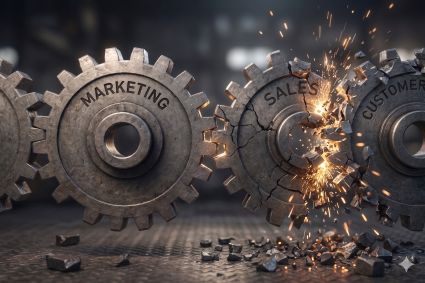
We depend on each other. I do my job so you can do yours. You do yours so the person next to you can do theirs. That dependence is the whole reason alignment matters. If none of us needed anyone else, we could each go our own way and it wouldn’t cost anything. But we do need each other, and when the handoffs don’t line up, things misfire and results founder.
So we try to align.
Our instinct is to use a model we know works: the assembly line. Fixed roles, clear handoffs, specific cadences. Every part and every step has a known relationship to every other part and step. When the work is repeatable, it works.
We’ve used the model for decades. Marketing creates awareness and drives demand. SDRs manage the leads. AEs take the leads, do the demos, get the PO. Customer service supports the customer. A clean assembly line, each part doing its job and handing off to the next part to do theirs.
We create charts and workflows to divide the work cleanly. Roles and responsibilities are assigned; org charts are developed. We set the metrics, define the handoffs, tune each step precisely. We build a revenue generation machine.
Then we face the real world, and the machine stops performing. Some parts of the organization aren’t producing what’s needed. Then the functions that are downstream stop working as well. Or what we’re producing doesn’t fit what the market actually needs. We add steps, change the work, eliminate steps. It works for a while, until something else changes.
Soon we start calling this an alignment problem. Our well thought out strategies and GTM designs stop delivering. We see an alignment problem: we aren’t aligned internally, we aren’t aligned with the market or our customers.
We call a GTM strategy meeting, we create new charts and workflows. Redefine roles and responsibilities. Perhaps revise the org charts. We design new metrics and dashboards. We’ve updated our revenue generation machine. We walk out of the meeting aligned.
But it happens again. The disruption recurs. It will always happen because the work of GTM isn’t an assembly line. An assembly line works because it does the same known thing over and over. Our work is more dynamic. Our customers’ needs change, our competitors change, the markets change, the technology and tools change. We must constantly adapt to respond to these changes.
We’ve built revenue machines to such tight tolerances that the ability to adapt to these changes has been designed out. The prospect won’t respond to marketing’s outreach. The SDR is qualifying for the wrong thing. The AE who doesn’t ask the right questions, even though he is following the playbook. The competitor who announces the exact capability the customer wanted.
The machine has no flexibility. It can’t change its process to match the shift in customer needs, the competitor’s actions, the shifting markets. Marketing keeps producing leads, but the wrong ones, or not enough. SDRs and AEs keep running playbooks that don’t work. The organization is stressed.
We’ve been living in this world for at least the past five years. Our well-designed GTM plans are failing increasingly in the real world of buying, selling, problem solving, and change.
Our instinct is to tighten things up. Push more volume through the machine. Do more of what we’ve always done. We hold more meetings, add metrics, set new goals. Leaders get more hands-on. Decisions move up. The drive is to get things back under control.
It’s the natural reaction when things start to come apart. It’s also the one move almost guaranteed to make things worse.
This is the flaw in most alignment efforts. Alignment itself matters; the problem is that we align the wrong things in the wrong way. We apply a model designed for a stable, predictable world to one that is constantly changing. The precision and predictability we design into the system cannot survive the constant disruption. The model that worked last year was not built for this year.
So when we talk about alignment, what is it we actually need to align?
It’s almost the opposite of what we’ve always done. It isn’t tight control. It’s a shared direction, but with the freedom for each person or group to decide how they work. When someone hits an obstacle, they have the freedom to adapt how they handle it, as long as they stay focused on the same goal.
Alignment starts with direction. It’s not, “We need to hit X in revenue!” It demands great clarity: What are we trying to achieve? Who are we trying to achieve it for? How will we know we’ve done it well? And what are we choosing not to do?
But direction alone isn’t enough. If we’re aligned on direction and everyone is free to pursue it their own way, we don’t have alignment. We have directed chaos.
We each depend on each other to do our work. AEs depend on SDRs doing their work. SDRs depend on marketing. So the freedom to adapt has a critical dependency.
When I change how I work, I’ve changed what I’m delivering to the people downstream of me and the work they’ve built around that. The freedom to adapt only works if it works for the people whose work depends on what I do. What does my change require of them? What do I need from them to make it work? What happens if they can’t, or won’t?
Likewise, in our freedom to change, we have upstream dependencies. Are the people I depend on able to make the shifts in what they deliver to me that are critical to what I’m doing?
Assembly lines do this well, even if it is done rigidly. At every step, everyone knows what is coming. When we trade rigid handoffs for the freedom to adapt, we can’t do this without being in alignment with the people around us. Active engagement is critical in any change we drive. It is what keeps everyone in the organization aligned.
The absence of this active engagement is where alignment falls apart. We make the change on our own, without telling anyone. This turns out to be, unintentionally, the standard operating mode. Marketing shifts its priorities and outreach messaging, but sales isn’t involved. SDRs change their qualification approach. We shift our value proposition to better compete, but AEs don’t know how to engage customers in discussing this shift.
While the organization stays aligned on the overall goal, it comes apart in the daily adjustments each of us makes.
Alignment isn’t just a one-time agreement on direction. We don’t get to gather everyone, agree on a direction, build the GTM factory, declare alignment, and walk away.
Alignment is a constant, dynamic process. It assumes constant change. And it assumes we can’t make those changes alone. It declares that as we adapt, we work with the people who depend on us, and as they adapt, they work with us.
The price of being able to change and adapt is maintaining contact with everyone else as things shift. That cost is real, and it’s why the easy reaction is always to tighten instead. Tightening feels like control. Staying aligned is work. It feels like it’s slowing us down, it feels much tougher.
But it’s this work that holds the organization together in our fast moving worlds.
The next time we start to see things getting shaky in the organization, we have to resist our impulse to tighten control. We have to ask ourselves a different question. Are we clear enough on where we’re going that people can adapt without losing the direction? And when they adapt, are we connected enough to each other that no one gets blindsided?
When we get this right, alignment isn’t something we fall out of. Alignment becomes the operating standard where we each stay in contact. We are committed to the same direction, and we achieve it by working together.
Afterword: This fascinating AI driven discussion is far better than the post. They introduce the idea of “dependence” more clearly than I did. They also leverage the concepts using the example of Jazz in a very powerful way. This is one that is a “must listen.”

