Companies are spending more on AI than ever before, even as the cost of AI itself has fallen. The price of running an AI query dropped 80 to 90% over the last two years. Total enterprise AI bills are skyrocketing anyway. Average enterprise AI spend rose from $1.2 million in 2024 to $7 million in 2026. The cost of running AI in production now consumes 85% of the AI budget at companies operating at scale.
Agentic workflows, the ones being marketed as transformation, consume 5 to 30 times more compute per task than the chatbot pilots that came before them. Earlier this year, Uber’s CTO told The Information that the budget he thought he would need was already blown away.
Across all of this, value realization sits at 55%. McKinsey’s 2025 survey found 94% of companies seeing no significant value from AI investment. Productivity gains where they exist range from 0.4 to 0.8%.
The standard explanation is that companies aren’t deploying aggressively enough. The argument runs: if you’re seeing marginal returns, it’s because you bought interface layers when you should have bought intelligence. You ran pilots when you should have eliminated stacks. You added AI to existing processes when you should have rebuilt the organization around what AI makes possible.
Be more ambitious. Move faster. Replace, don’t augment. Let the recursive engine compound.
Parts of that argument are right. Companies that build adaptive systems do pull ahead, and the gap widens over time. Adding AI to existing processes is exactly the failure mode I described in The AI-Native Illusion. Replicating poorly thought-out processes at scale will produce mediocre to poor results at scale.
But the high-ambition version of the argument has the same omission as the Interface-native version it claims to surpass. Both are answers to the question, “what AI should we deploy.” But these questions miss something. We are missing the foundational questions that are part of every transformation. We must address these first. They are:
What is our business actually for? What can we now do that we never could do before? How is it important to our customers, our markets, our organization?
Those sound like questions any senior leader can answer. They aren’t. Most cannot answer them without retreating to the standard corporate or investor decks. They talk about mission statements or product descriptions or revenue targets. The mission statement is not what the business is for. It’s what the business says it’s for, in the language that survived legal and PR review. Revenue is not what the business is for either. It’s the result of doing something useful for someone who’s willing to pay. Product descriptions describe what we sell, not what we’re for.
What the business is for is the answer to a harder question: what customer outcomes do we exist to create that wouldn’t exist without us? Not what do we sell, not what do we measure, not what’s on the website. What changes for the customer because we exist, and out of all the things we could do to produce that change, what are we distinctively positioned to do better than anyone else?
Underlying this, is what do we want to stand for with our customers, employees, investors, and community?
Companies that can answer these questions can have useful conversations about AI. Instead, everyone skips over these, starting in the middle of a discussion without considering these prerequisites.
Part of the reason this is done is the fundamental questions are tough work. They involve deep understanding, thought, and discussions in the organization and with customers. Part of the problem is momentum. We focus tactically on what’s next and how we do more, seldom revisiting these foundational questions.
This is where the cost data starts to make a different kind of sense. The exploding bills, the marginal productivity returns, the value realization at 55% are not symptoms of insufficient ambition. They are symptoms of organizations deploying AI without having answered the foundational question.
When you don’t know what your business is for, you can’t tell which AI deployments serve it. You deploy what’s available, what’s marketed, what the vendors are pitching, what looks like motion to the board. You optimize for measures that focus on activity rather than outcomes. The bill goes up because nothing in the deployment decision is calibrated against actual purpose.
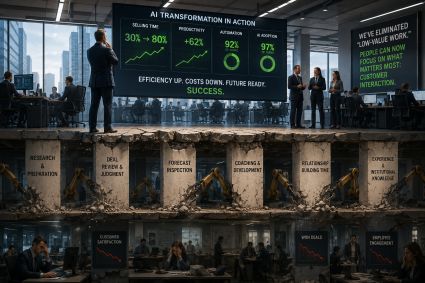
The high-ambition playbook makes this visible in a particular way. Read the typical case study. The story is usually that AI eliminates the “low-value” work, logging, prep, pipeline review, follow-up drafting, contact research, forecast assembly, so people can spend more time on the high-value work, usually defined as customer interaction. The metric that gets celebrated is something like, “sellers went from 30% selling time to 80% selling time.”
That metric is the tell.
Selling time is not what sellers produce. Selling time is an input, badly measured. The output of a seller is customer outcomes. Relationships built. Problems solved. Deals that close because they should. Deals that don’t close because they shouldn’t. Accounts that grow because the seller understood the customer’s business well enough to find the next thing that mattered.
What’s also missed in what’s called “low-value” work is the knowledge and judgment that’s built in doing it. How do we effectively communicate with and connect with our prospects and customers? How do we most effectively leverage the research in our meetings? What are the factors that impact the forecast of a particular deal? The numbers and the data don’t contain the experience, judgment, and insight. AI can certainly contribute, but the idea that all of this is low-value demonstrates a huge misunderstanding of the work itself.
When you optimize for selling time, you have measured the wrong thing. You’ve assumed that more time in front of customers automatically produces more value created with customers, which is only true if the seller has the judgment to make that time count.
The judgment is the part that doesn’t get discussed.
Sales, and this generalizes to most knowledge work, isn’t a set of discrete tasks. It’s an apprenticeship in judgment. The pipeline review where a rep gets challenged on a deal by a manager who has seen a thousand deals, that’s where the rep learns to read a deal. The prep work where a rep researches an account before a call, that’s where she develops the business and relationship knowledge that lets her hear what the customer is actually saying. The follow-up the rep drafts herself, that’s where she learns what trust feels like in writing, and what the cost of getting it wrong looks like when she doesn’t connect in a meaningful way. The forecasting process where she has to defend her numbers, that’s where she develops the discipline to know what she actually believes versus what she’s hoping for or the report is telling her to do.
Strip those tasks out and the activities are gone, but so is the apprenticeship. The seller who never builds her own pipeline view never learns to read one. The seller whose customer research is automatically given to them never develops the relationship knowledge that makes intelligence useful in front of a customer. The seller whose forecast is assembled by AI never develops the discipline that produces forecasts that matter.
Keenan made a version of this point recently, quoting a head of enablement who said the quiet part out loud: we trained reps on tools for years, we never really trained them to be good at the conversation, and now the conversation is what we’ll need them to do. He’s right about what’s been happening. The activity layer the SaaS economy built around sellers absorbed the energy that should have gone into developing judgment. AI is now exposing what was actually being produced underneath.
The high-ambition playbook treats all of that lost development as overhead. Cost. Friction. Stuff to be eliminated so the human can do the “real” work. But the real work doesn’t separate cleanly from the apprenticeship. The capacity to do the real work is built in the very tasks being labeled low-value. Eliminate them and you don’t get a seller with more time to be excellent. You get a seller who never developed the capacity to be excellent and now has time on her hands.
And we’ve seen this before AI showed up. Strictly scripting people. Using dashboards without understanding what they mean. The inability to truly understand and engage customers with impact. We’ve watched years of performance decline as a result. AI taking the work away doesn’t improve the skills of the people executing what remains.
This is the people question that the AI conversation systematically avoids. It avoids it because addressing it would force a much harder set of questions. What are we actually trying to develop in the people who work here? What capabilities does the work itself produce that we’d lose if we automated the work? Where does AI extend human capability versus replace the conditions that build it? Where is the apprenticeship in our roles, and what happens when AI removes it?
These questions are uncomfortable because they don’t have vendor answers. They require leadership to know what excellence looks like in the work, and to know where it gets built. Most leadership doesn’t know, not because they’re stupid, but because the conditions that produce excellence have been eroding for years. The metrics-driven, activity-managed, compliance-scripted version of most knowledge roles already removed most of the apprenticeship. AI is finishing what activity tracking and call recording started.
So when we talk about starting with the business rather than starting with AI, this is what we mean. It isn’t a process recommendation. It’s a recognition that the question “what AI should we deploy” only has good answers when we’ve already answered the prior questions. What is the business for? What customer outcomes does it exist to create? What can we do that we’ve never been able to do before? What excellence does that require from the people who do the work? What conditions produce that excellence?
These take real strategic thinking. Most companies don’t do real strategic thinking. They do market positioning, financial planning, and roadmap prioritization, all of which are downstream of strategy but not strategy itself.
When real strategic thinking is happening, the dialogue between strategy and capability becomes natural. You know what you’re trying to be excellent at, so you can evaluate which AI capabilities actually serve that excellence, which substitute for it, and which would erode the conditions that produce it. The deployment becomes a portfolio of choices made against a clear standard.
When real strategic thinking isn’t happening, the dialogue can’t happen because half of it is missing. There’s no clear answer about what the business is for, so there’s no standard against which to evaluate AI deployment. The vendors fill the vacuum. The metrics fill the vacuum. The board’s questions about AI fill the vacuum. The deployment becomes whatever survives the budget cycle and produces the cleanest case study, which is usually whatever maximizes what’s measurable rather than what matters.
This is why the cost data looks the way it does. Seven million dollars in average annual AI spend. Fifty-five percent value realization. Productivity gains under one percent. Bills running ahead of every projection finance teams made.
Organizations aren’t being stupid. They’re responding rationally to incentives in an environment where the foundational strategic question never got asked. The vendors have done well. The boards are satisfied. The bills are coming due.
There’s a version of this where a leadership team actually sits down and answers the questions. What customer outcomes do we exist to create? What excellence in our people produces those outcomes? What conditions develop that excellence? Where does AI amplify what we’re already trying to be, and where does it replace the conditions that produce it? Where is the apprenticeship in our work, and what happens when AI removes it? These aren’t AI questions. They’re business questions. The AI questions only become tractable after they’re answered.
Almost no leadership team is doing this work. Some can’t because they don’t have the capacity for that kind of strategic thinking. Some won’t because the answers would force changes they’re not willing to make. Some are too busy responding to vendor pitches and board pressure to make the time. The result is the same. AI deployment without strategic foundation. Activity without purpose. Bills without returns.
The question worth asking isn’t “what AI should we deploy.” It’s whether anyone in the organization is doing the prior work that gives AI deployment any meaning at all.
If they are, the deployment will pay off, eventually, in ways that show up in customer outcomes rather than in productivity dashboards. If they aren’t, no amount of ambition will save the deployment from the same fate as the Interface-native crowd. Different mechanism, same disease, same bill.
Afterword: This is the AI generated discussion of this post. It’s fascinating, they start with an example of dropping a F1 Car onto a dirt road, saying the car can’t achieve it’s potential because of the limitations of the road. They bridge into a fascinating discussion of this post. Brilliant! Enjoy.

