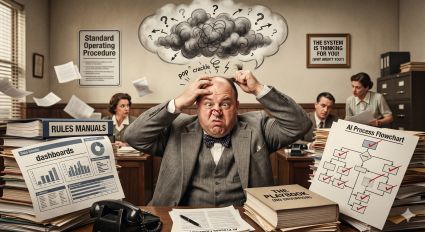
Judgment is the capacity we need most and are developing least. Every organization says it wants people who can think, who can navigate ambiguity, who can make the right call when the situation doesn’t fit the playbook.
Yet, too many organizations create management systems designed to make judgment unnecessary. They have built processes to standardize decisions, rules to remove subjectivity, dashboards to replace observation, playbooks to substitute for thought, and now we are turning to AI in the hope that it will relieve us of the need to think altogether. We tell ourselves this is about scaling, consistency, and efficiency.
But it’s actually fear.
To understand what we’re losing, it helps to understand what judgment is. Judgment is the ability to make good decisions in situations where the right answer is unknown.
It is not the same as knowledge, though it requires knowledge. It is not the same as analysis, though it uses analysis. It is not the same as experience, though experience is where it comes from.
Judgment is what happens when a person looks at a specific situation, with its particular facts and the associated risks, and decides what to do in the absence of rules that address the issues.
Every important decision is a judgment call, because the decisions that don’t require judgment are the ones we’ve already automated or proceduralized out of existence. The more an organization succeeds in removing judgment from its operations, the more important the remaining judgment becomes, and the less expertise people have in exercising it.
We have abandoned judgment, gradually, for reasons that seemed to make sense, or because we just weren’t paying attention. Processes emerged to capture what good people were already doing, enabling less experienced people could approximate the same result. That was reasonable, we used the process to help develop the capabilities and judgment of these less experienced people.
Then processes became mandatory rather than instructive. People stopped understanding how to use the process effectively, but merely checked the boxes. Managers were relieved because variation was hard to manage. It took them more time and required deeper understanding and engagement with their people.
Then metrics were attached to the processes, because what gets measured gets managed, and soon the metrics became the work rather than a reflection of it. Checking the boxes and going through the motions became the goal.
Then the steps requiring judgment were identified as bottlenecks and engineered out, because a decision that requires a person is slower than a decision that doesn’t.
The roles that had required judgment got redefined around the process, and the people who had exercised judgment either adapted or left, and the people hired to replace them were hired to execute, not to think.
Part of this was done in the name of efficiency and cost. If we could hire a person with less experience into a job that didn’t require judgment, we wouldn’t have to compensate them as highly as those roles that required judgment.
Then scaling amplified this practice. Judgment, even thinking, was designed out of the process, the focus was just on getting more people to read the scripts and check the boxes.
At the time, these actions seemed reasonable and productive. But then things started changing. Growth became more difficult, performance and engagement plummeted. Those few that tried to exercise judgment are increasingly asked to justify their calls against data that focused on activity. While they exceeded their goals, they were punished or fired because they didn’t make the required number of outbound calls or conduct the number of standard demos.
The consequences are everywhere once you start looking. Sellers who can’t adjust to what a buyer is actually telling them because they’re stuck to the script. They neither hear nor understand what is being said.
Managers who can’t coach because coaching requires judgment and the system only lets them manage to the numbers. And worse, they don’t understand what caused the numbers.
Customer success teams who miss the signal because it wasn’t in their scripts.
Leaders who can’t respond to a new competitive threat or a market disruption because the disruption didn’t align with the strategic planning cycle. Or, more importantly, they failed to look outside the organization to understand what was happening in the markets.
Boards that reward predictable mediocrity because variable excellence is harder to explain. And underneath all of it, a workforce that has been told for years that their job is to follow the process and now finds itself in situations the process doesn’t cover.
The fear of judgment permeates every level of the organization. But it’s important to understand what drives this fear at each level:
- At the individual level, exercising judgment is exposing. If you follow the process and it fails, the process failed. If you exercise judgment and it fails, you failed. The rational response to career risk is to hide behind process whenever possible, and to develop judgment only to the extent that you can’t avoid it. We’ve built a system that makes this the intelligent personal strategy, and then we wonder why our people won’t think.
- At the managerial level, letting people exercise judgment means being accountable for outcomes you didn’t directly control. Every manager has learned that the safest posture is to limit their people’s discretion and monitor their compliance. This seems like management, in reality it is the opposite. Real management is the development of judgment in others, but constrained people do not develop judgment.
- At the organizational level, judgment creates variance, and variance is hard to forecast, hard to plan around, hard to identify in describing quarterly performance. We prefer predictable mediocrity to variable excellence because predictable mediocrity is easier to defend in an earnings call.
- And at the cultural level, there is uncomfortable reality that taking judgment seriously means admitting that some people have better judgment than others. This contradicts the conventional fiction that roles are interchangeable and that anyone executing the process should produce similar results. If that assumption is false, the org chart is a lie, the compensation system is a lie, the hiring rubric is a lie. Most organizations would rather preserve the lie.
Judgment develops through iterations plus feedback that matters. You make a decision, you live with the consequences, you talk through what happened with someone more experienced, you learn, adapt, and over time you get better.
This is apprenticeship, and apprenticeship requires three things: Junior people empowered to make decisions, to deviate from the script or process when it doesn’t fit the situation. It requires experienced people with the time and inclination to develop these junior people. Finally, an organizational recognition that this development is critical to success, both of the individuals and the organization.
We replaced all three with training programs, which teach content but not judgment. With enablement platforms, which teach process but not thinking; and with certifications, which prove compliance but not capability.
The result is a generation of professionals think they are being developed. But instead, they have been trained, which is not the same thing. Training transfers knowledge. Development builds judgment. One is a program. The other is developed over years, but we don’t have time for it.
And now, we see the arrival of AI. And, unwittingly, it creates the most dangerous version of this model we have been refining for decades.
Our focus on efficiency says that AI can make decisions faster, remove friction, replace the need for a person to think. If the person wasn’t thinking very well to begin with, this sounds like a win.
Organizations already uncomfortable with judgment now have a sophisticated way to avoid it: faster decisions, consistent outputs, scalable results, no more dependency on humans.
This framing treats AI as the final step in years of effort to make judgment unnecessary, and it is going to produce a generation of professionals who have never had to think hard about a difficult decision, because a machine produced the answers and the people only had to execute it. Or AI takes these roles, as well!
The quality of outcomes have the potential to degrade in ways the metrics will not capture, because the metrics were built to track process compliance and AI produces excellent process compliance.
The absence of judgment will show up in lost deals with reasons nobody can articulate, in customer relationships that erode, in strategic decisions that look defensible but are catastrophic in retrospect.
And worse, people who are no longer excited, engaged, or care.
There is another possibility, but it challenges so much of what we have done in the past. AI can be a thinking partner. It can challenge assumptions, help you discover what you missed, stress-test arguments, play back your reasoning so you can examine it.
Used this way, AI doesn’t replace judgment, it develops it, because we are forced to engage with the output. We are required to push back, think differently, expand our field of vision, and decide.
This is harder than letting AI do the thinking, which is why most people and most organizations will not do it. It requires the us to value judgment, to see AI as input to our thinking, not a substitute for it. It requires us to accept the slower pace that real thinking requires, recognizing how critical this is to effectively drive the outcomes we seek.
Organizations that want judgment-capable people will structure AI use this way. Organizations that want efficiency will structure AI use the other way and will not understand why their people get less capable over time. Or they may not care because AI is doing that work. Or worse, they may not recognize this, because their own ability to exercise judgment no longer exists.
Turning this around, developing and leveraging judgment is possible, but it starts with seeing clearly what we’ve given up by designing judgment out.
We’ve lost the ability to respond to situations our processes didn’t anticipate. We’ve lost the people who could have grown into our most capable leaders, because they left when we stopped asking them to think.
We’ve lost the trust between managers and their people, because trust requires judgment. And we’ve lost the engagement that comes from work that requires us to exercise judgement.
Once we see what we’ve lost, we can begin to recover it.
At the individual level, three commitments matter.
First, take decisions you would normally avoid. Where the process, script, checklist doesn’t fit, make the call yourself, knowing that you might be wrong. Judgment only develops and improves with practice.
Second, reason in the open. Before a significant decision, think about it. What alternatives have you considered, why are you making the choices you are making, what might you do differently? Afterward, come back to it and examine the reasoning, not just the outcome. Did you make the right assessment, what did you miss, what might you have done differently?
Third, invert how you use AI. The default is to ask AI for an answer, doing what you’ve been told. The developmental move is the opposite. Take a position first, then use AI to stress-test it. This keeps you in the driver’s seat of your own thinking.
At the organizational level, three changes matter most.
First, push real decisions down. Identify the decisions being escalated not because they need senior judgment but because people closer to the work have been trained not to exercise their own. Empower people to make decisions on their own. Encourage them to seek help, coaching and ideas, but let them make the decision. Some will be made badly, but it is through this, we learn, develop, and grow the capabilities of the organization to make more and better decisions. And through this, we build a critical capability the organization doesn’t have.
Second, rebuild apprenticeship. Pair junior people with experienced people in the actual work, not in a training program. Protect the time of your best people to develop others, and value that work in how they are evaluated.
Many organizations claim to do this, but few really do. People development produces no visible ROI in the current quarter. Changing this is a leadership choice, not an HR initiative.
Third, change what gets asked in reviews. The dominant review question is some version of “did you follow the process and hit the number.” Replace it with “walk me through your thinking on the hard calls you made this quarter.” Reward good reasoning even when outcomes were mixed. Probe weak reasoning even when outcomes were strong. What you ask about is what people prepare for.
And today, things are changing. We think the choices are about AI, but it really isn’t. It’s about whether we believe judgment matters enough to develop it in ourselves and our people. It’s whether we encourage managers to tolerate the variance that judgment creates, to build the trust it requires, to develop their people’s judgment rather than training them out of it.
If we’ve decided judgment is a bottleneck to be engineered around, AI will finish the job. If we’ve decided judgment is the capacity we most need to cultivate, AI can be the most powerful development tool we’ve ever had. The technology is neutral. The answer is not in the tool. It’s in what we think people are for.
Of course, all of this is just a judgment call. The challenge is, can you make it?
Afterword: Another fascinating AI generated discussion of this post. Enjoy!

