Too often, we think of the customer’s buying process as something that, once we understand it, is fairly structured and defined. Our job as sales professionals becomes aligning our selling process with the customer’s buying process, moving through the process in a disciplined manner.
I think there is a different view of the buying cycle, one that is more “squishy.” Hank Barnes of Gartner, has an interesting concept of the buying cycle being a series of “activity streams,” each going at various speeds. These streams are constantly working–but with differing levels of focus and activity. The outcome of these buying streams may result in a purchase–or no decision, depending on how the customer aligns themselves and manages the process. Hank pictures the process something like the picture below.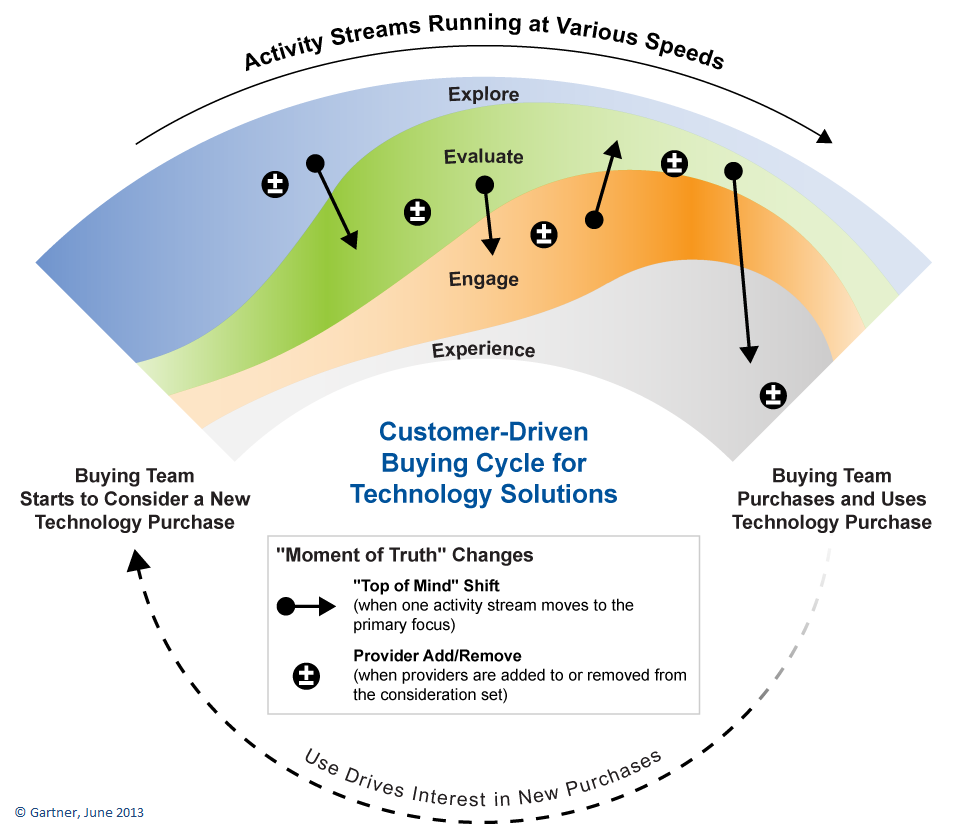
I think this picture represents a lot of what I see in B2B buying cycles. Customers are always exploring, looking for ways to improve, seeking new ideas. Every once in a while, something captures their attention. They may evaluate making a change to the way they do things—note this isn’t necessarily evaluating a solution. At some point, they begin to formalize things, organizing themselves to buy, engaging others, both inside the organization and outside the organization. They may make a buying decision, gaining more experience in the implementation. Over time, they look to improve and may reenter the cycle.
Contrary to what many think, this process is very fluid, constantly changing. At some points, activities in a certain value stream are stronger than others. The customer may “enter” and “exit” a formal buying process at any time. They may or may not actually decide to change.
This presents challenges for sales professionals:
How do we know when the customer is going to buy? In their “exploration” phase, we can invest a lot of time but they are only exploring.
How do we know when they are truly serious, that they intend to buy? As the diagram outlines, all these cycles are going on simultaneously. The outcome of any cycle could be to enter into a buying cycle and actually buy, or it could be deferred, moving into more exploration.
Do the customers really know how to buy? Various players, within the customer, can actually be in different activity streams at the same time. Some might be exploring, some may be evaluating, still others engaging. However, until they are all aligned and in the same activity stream at the same time, they won’t buy.
What happens if they move through these and we don’t know or get involved too late? Customers leverage multiple resources and channels in their evaluate and engage process. We see, increasingly, they don’t involve us until very late in the process.
So there are lots of challenges, but out of these challenges there is great news and tremendous opportunity:
First, we don’t have to wait until the customer is “in” a buying cycle. Since they are constantly exploring, evaluating, engaging, and experiencing–we have the opportunity to drive a buying cycle. Through compelling Insight, thoughtful conversations about new opportunities or ways of doing things differently, we can influence and alter these activity streams. We have an opportunity to disrupt this process.
By making the “pain of doing nothing” greater than the “pain of change,” we can drive the buying process. We can move the customer through the cycles of exploring, evaluating, engaging, and experiencing.
Second, we can offer real leadership in helping the customer organize to buy. Each player will in a different activity stream. By helping the customer organize, align, and define their process we can help the customer move through these activity streams in a disciplined manner-culminating in a buying decision. We can add structure, discipline, and focus to this “squishy” process.
Third, since this cycle never stops, we can continue to engage and grow our impact with the customer, helping them improve their execution and grow. In crass sales terms, growing our share through cross sell and upsell.
The “squishy” buying cycle offers us tremendous opportunity to provide leadership, collaborate, and create value. The “squishy” buying cycle demonstrates the importance of providing leadership through compelling Insight, moving the customer purposefully through the buying cycle.
Are you prepared to take advantage of the customer’s “squishy” buying cycle?
This post was written as part of the IBM for Midsize Business program, which provides midsize businesses with the tools, expertise and solutions they need to become engines of a smarter planet. I’ve been compensated to contribute to this program, but the opinions expressed in this post are my own and don’t necessarily represent IBM’s positions, strategies or opinions.