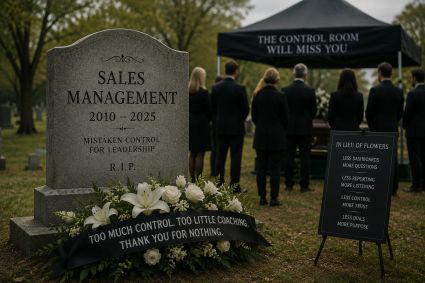
It must seem strange to see the author of The Sales Manager Survival Guide writing about the death of sales management. Clearly, something is off.
Even worse, I’m cheering this on!
Before you burn your copies of the book or take any other rash actions, let me explain myself.
The job of the sales manager has devolved over the past ten years. It’s now become largely an administrative and reporting function. It’s also taken on a super seller function, with managers injecting themselves into deals to negotiate and go for the win.
How has this come about?
Over the past 10-15 years, the sales role has been increasingly mechanized. Traditional selling roles have been chopped up, specialized, using a manufacturing model. Customers are widgets that move along an assembly line to create predictable revenue.
When you look at managing a manufacturing line, you see control rooms with people managing dashboards adjusting performance. Turn a dial here, a switch there and you manage the automated line. A few supervisors, walk along the line, occasionally jumping in to help workers where needed.
Sales management has modeled itself after this. Too much time in managing the dashboards. When sellers need help, or even if they don’t, managers create value by jumping in, doing the work themselves.
Time spent coaching and developing their people has plummeted. Research shows managers spending less than an hour a week coaching everyone. Then when we examine the coaching they do, it’s largely directive. Feedback becomes, “you are missing your activity metrics.”
Through this same period of time, we’ve seen continued declines in performance. Standard win rates are 15-20% and in some sectors we see them lower. Percent of people hitting quotas is in the low 30s. Organizations making goal declines. Employee engagement declines, turnover increases. Even sales manager tenure, at all levels, is only 11-18 months.
Clearly there are a lot of factors that contribute to these declines, but it is the responsibility of sales management to identify and correct these.
And it hasn’t been working!
Classic solutions these managers put in place is to churn the people. Fire low performers, replace them. Change the sales process and methodology. Add more technology and tools. Add more metrics, which change nothing but report in more detail.
And these solutions aren’t working.
Blame it on market conditions. Blame it on competition. But the manager’s job is to understand these market conditions and the competitors, putting in place strategies to address these.
Then we get to the concept of the overall GTM strategy. Theoretically, leaders develop strategies to map how the organization will achieve it’s goals. Identify new market opportunities, shift resources, move from direct to partner to indirect to PLG to account based, segment markets and approaches, the list could go on.
But the prevailing strategy for the past 10 years is a scaling strategy. Do more of what you have always done. If you aren’t reaching your goals, keep scaling until you reach them.
I’ll stop here, you get the point.
And now layer in AI.
We are quickly finding AI is better than your SDRs. So SDR roles are eliminated. AI doesn’t need coffee, lunch, or bathroom breaks, it runs 7×24. It runs at speeds an efficiencies far greater than any human being can do. Demos, AEs, AMs all are having their jobs downsized, though volume, velocity is upsized by AI.
Managers sit in their control rooms turning the dials, increasing volume and velocity, doing everything they can to achieve the goals.
Guess what! If that is what management has become, AI can manage the control room better than managers.
So we can see the death of sales management. And as ironic as that seems, I’m cheering it on! It’s the best thing to hit sales management in over a decade.
OK, OK, you know I’m going to put a twist into this. What is it?
Over years, we’ve mistaken control for leadership.
We’ve systematically engineered judgment out of seller jobs and out of management.
We’ve standardized, instrumented, measured, automated. We create scripts and playbooks, build dashboards, established countless metrics.
Increasingly, managers have become operators of the machine rather than leaders of people. And all the engagement studies continue to validate this.
But now the “machine” can manage itself. We no longer need the control room.
So what’s left for leaders?
Dashboards tell us what is happening. They don’t tell us why.
The work of leaders becomes understanding what’s changing, then deciding what matters.
It’s challenging assumptions, making choices. Engaging people in the process and helping them understand and own the choices that have been made.
It’s determining the current capabilities of the organization and the capabilities the organization needs. Then working with the team to put these in place.
It’s creating the conditions where people can perform at their highest levels. Developing their judgment, helping them to adapt when the playbook doesn’t work.
It’s creating meaning and purpose.
It’s creating an organization that can figure things out, rather than waiting for the answers to be provided. Helping people navigate in a constantly changing world.
It’s less about maximizing the performance of the system we have, but more about building the organization prepared for what comes next.
Now the scary part. You are sitting there thinking, “Dave I get it. But I’ve never actually done it. What do I do?”
This is a first things first question. Before we can develop our sellers, we have to first redevelop our leaders.
We now have a generation of managers up to and including CEOs and CROs who have never done anything but sit in the control room, tweaking the dials.
Since they are no longer needed in the control room, how do they learn while managing an organization at 200mph?
The only place left to go is where the work gets done. The messy reality of working with the people doing the work that only they can do. It’s sitting down with people in the organization, with customers, with partners.
In the process of understanding what’s happening, reimagining the future, leaders are confronted with relearning or developing judgment.
These walkabouts are not just learning, but they are about choosing. It’s deciding what to do next.
“What is the most important issue I should be dealing with? What are the most important issues the managers reporting to me should be working on?” Answering these questions requires the exercise of judgement.
The senior leader starts cascading this through the organization. Rather than asking the VP why they aren’t hitting their numbers, the better question is, “Our win rates have been declining for years. What’s happening, what do you think we should do?” The VP might go to their managers asking, “We create plenty of pipeline, but it’s not converting? What’s happening with the opportunities we are pursuing?” And the managers might coach their people, “Which customers should we be focusing on? Which should we stop? What are we missing in selecting the right opportunities?
The shift moves from giving answers to asking questions. To answer these, each individual has to understand, then exercise judgement in making choices.
Once they have done this work, we have to trust their choices and let them act. Some of these choices will work. Some will fail. Leaders can never prevent every mistake. But their job is to help people learn from them, moving forward based on what they have learned.
It’s only through failure that we build judgment, experience, and discernment.
You can see this drives another shift.
We have come to think management is about control, hence the rise of the dashboards and control rooms.
In reality, leadership is about releasing control.
Not blindly or arbitrarily, but after everyone is aligned around the purpose of the organization and is focused on what really matters. Then trusting them to exercise judgment in figuring it out.
The goal has never been about creating organizations that require more control. It’s to create organizations that need less of it.
Afterword: Another fascinating AI discussion and interpretation of this post. Enjoy!

