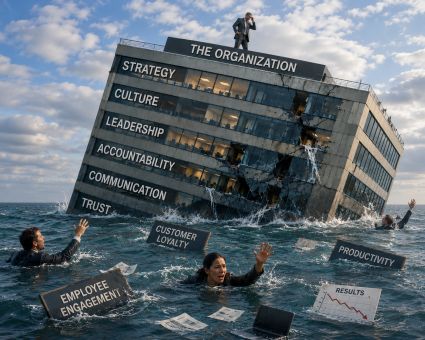
A few months ago, I was having a conversation with a talented CEO. His company was struggling and we were talking about how to turn it around. In a moment of frustration, he shouted, “I’m the Captain of this ship, I’m the only person that can save it!”
His frustration and reaction isn’t unusual, we see leadership heroics every day. Whether it’s a front line manager diving in to save a deal, or a senior leader taking over, making all the decisions and directing every action.
In reflecting on this, I thought of the Captain of the ship expression. I wondered, is this how a Captain of a ship really works, particularly under pressure? As it happens, my brother in law, Tyler, is a retired Navy officer. He has captained destroyers, cruisers, even a specialized version of an aircraft carrier. So he has experience in a running a $billion plus operation with thousands of people on the oceans.
I described the frustration of the CEO to him and the expression, “I’m the Captain of this ship, I’m the only person that can save it!” Tyler started laughing. He said, “Do you know how big an aircraft carrier is, do you know how many things that can possibly go wrong?”
After overwhelming me with the size and number of moving parts on the last ship he commanded, he said, “The Captain of the ship never saves it. It’s the crew that saves the ship!”
This is a critical point, the Captain’s of every ship in the world know this, they aren’t the people that save the ship, it’s their crews that save the ship. It’s something too many leaders miss when their organizations are struggling.
But I didn’t let Tyler off the hook. I said, “Well when the ship is in trouble, what do they do to keep the ship from sinking?”
He said, “Dave, you have to back up. What my job was was to minimize the possibility of anything that could cause damage to the boat happening.” (As a side note, I find it amusing that naval officers commanding massive ships always refer to it as a boat.)
“From day one, each crew member has to know what their job is. They have to know how the boat works and what doing their job right means to keeping the boat operating. They have to know how the work they do connects to the work of everyone else in the crew they work with.
“It’s the responsibility of the chiefs and officers that command them to make sure they understand their jobs and they are doing it. We constantly train on that and we constantly train on how to handle things when they start to go wrong.”
I interrupted, “I get it, that’s how to make the ship work normally, but when something happens and it goes wrong, what do you do?”
Tyler continued, “First we do everything we can to minimize that happening. We constantly inspect the ship, we make sure people are doing their jobs correctly to make sure the possibility of something happen is minimized. But then we spend a lot of time looking at what might go wrong. If a major component of the ship broke, if we are hit by something, if we are attacked.
“We look at hundreds of scenarios of what possibly could go wrong and how we avoid it. Then we spend hours and hours figuring out what to do if these things happen. It’s not the leadership team of the ship, it’s leadership team working with the crew. We sit down with dozens of groups looking at what we do if something goes wrong. Each crew member is involved in the process. Each crew member knows they have a role.
“Then we practice, we look at how we respond when something happens. We are constantly training everyone in their roles when a problem arises.”
I interrupted, “I get it Tyler, I get the constant work, training and practice. But when something happens, what does the Skipper do?”
He replied, “My job is simple. I want to make sure we’ve identified the right problem. I want to make sure my crew knows the problem. They know how to deal with it because they have been trained on these problems before….”
“Then there are a few other things that are critical. I want to get out of their way so they can solve the problem. And I want to make sure they are getting all the support and resources they need to do the job they know how to do?”
As I reflect on my conversation with Tyler (he lives on the California coast and we had this conversation over a few beers overlooking the Pacific), I thought, “How many business leaders understand this? How many are preparing their organizations for the same thing?
The Captain of the ship can never be the person that saves it. It’s the work of the entire crew, doing the jobs they’ve been trained to do, getting the support they need from the leadership that saves the ship.
This brings me back to the frustrated CEO. Here’s the thing: the ship wasn’t sinking. It was a high-growth organization, everything working, and he was drowning anyway. Everything was landing on his desk. He’d started questioning whether his team was really doing their jobs. The more the company grew, the more he felt himself going under.
As I reviewed both my conversation with Tyler and this CEO, I recognized a key difference. Tyler spent his whole career trying to make himself unnecessary to the save. If he were hit, injured, off the bridge, the crew still ran the ship.
This CEO had done the opposite. He’d made himself necessary to everything. The drowning he described wasn’t the “ship” going down. It was him. The good news is the business was facing the strains of rapid growth. The problem is, he’d built the organization in a way that very little moved without his involvement. The company had been built around him.
What does all this mean to you? You may not be in crisis, but not achieving what you or the organization want. You may not be “commanding an aircraft carrier” like Tyler. You may be by yourself in a dinghy.
Look at your desk, your email inbox, and your computerized task lists. When something new pops up, do you drop everything and jump in to handle it? At the same time dropping everything else you were working on. Do you think about whether you should even bother with it, or is it a distraction? Can it be deferred? Are you the person that should be handling it?
Leaders, take a moment and reflect on your organization. Are your people behaving in this same way? Do they feel the same overwhelm and are they wired to react respond? Do they know their jobs and how they should be doing it at the top level? Do they have the ability to figure things out if things go wrong? Are managers engaging properly, helping them figuring it out rather than rescuing the situation? Are your people getting the resources and support they need?
Then, ask yourself the deeper question, can your “ship run without you?”
I know what’s going through your mind, “What do I do if they don’t need me?”
That’s the question most leaders seem never to have the time to ask. But the answer to this question is where the real job of a top leader lies. They free the top leaders up to think about the strategy, the future of the organization, the changes and development necessary to pursue this future.
Too many never get the chance to pose this question. Being needed, feeling helpful feels like leadership. But those are the very things that keep leaders from leading.
These are not easy questions or answers. It takes time, working with your organization to figure them out and then how to take action. It takes time to get to the point to ask yourself, “What do I do if they don’t need me?”
But isn’t that where you really want to be? Isn’t that what your job is really about?
Afterword: Normally I’m very enthusiastic about these AI commentaries on these posts. There are always some small errors, mostly in pronunciation of acronyms. This has me scratching my head. It’s pretty accurate, but they are struggling a little in the discussion. Perhaps they don’t yet have their sea legs 😉 But you may enjoy it, if only to see where they aren’t quite getting the point. Enjoy!

