For years, we’ve known our customers are overwhelmed with information. Where information scarcity had been a problem, which caused customers to invite sellers into their offices, for the past 10-15 years, it’s been the opposite. Customers are overwhelmed.
Sensemaking was created for sellers to help customers deal with the information overload. It enabled sellers to sit down with customers to help them filter through things, focusing on the information that was most important for their situation.
We are facing another “overwhelm” moment, which creates a need for Sensemaking 2.0. But this time, it’s not our customers facing information overwhelm, it’s every part of our GTM organizations. The thing that’s overwhelming us are signals.
Technology has given us the capability to track thousands of signals. Every interaction a customer might have online, every search, every page or click on a related topic. Clicking on our website content, downloads, email opens/forwards, social media. Tracking these used to require very advanced mechanisms, but today they are child’s play.
Vendors of these tools proudly talk about the 1000s signals that are translated into 100s of leads they provide each of their customers every day. One vendor told me they were providing every seller with one of their customers over 150 leads a day. But when they actually talked to the sellers, they were overwhelmed, to the point they were ignoring the leads.
You can see where I’m going. We are overwhelmed with signals. Just as our customers struggled to figure out what information was most important and made sense, signal overload overwhelms our capacity to judge.
Before we look at applying Sensemaking 2.0 to this challenge, let me step back to look at signals and their value or lack of value.
Signals are only important if they strengthen our understanding of what to do next. Most of the signals we see represent activity data. It’s often presented as insight by correlating it with past results. But signals show what has happened, but don’t necessarily tell us what it means. By themselves, we don’t know what’s important and what to do.
A person downloading a white paper may be researching something to help in a change, or it could be a person just interested in learning about a topic. A collection of signals, analyzed and presented to someone is meaningless until that person does something with it. Signals that don’t help them move forward in high impact ways are meaningless.
If we look at where signals fit in our work, we can leverage the following model:
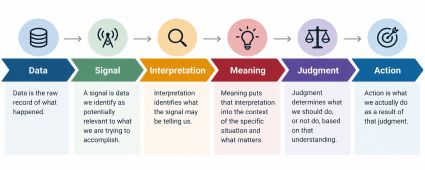
As we look at this, we see:
- Data is raw information.
- A Signal is the data we identify that is potentially relevant to what we want to accomplish.
- Interpretation helps us understand what the signal might be trying to tell us.
- Meaning puts that interpretation into the context of a specific situation.
- Judgment establishes what matters and helps us determine what to do based on that understanding.
- Action is what we do as a result of the judgment.
We’ve gotten very good with the data and signals. AI and related tools are getting better at interpretation. But interpretation without context doesn’t create meaning. And meaning without judgment doesn’t produce focused action.
At the risk of repeating myself. We are overly excited about signals, the vast quantity we can collect and the analytics to interpret them. But until we understand the meaning, make judgments based on that, then take relevant action; signals are just noise.
Now here comes the, “Oh sh*t” part. Just imagine the thousands of signals we are getting, how do we sort through those that are most important? Do we dump them on a seller saying, “We’re tracking what you do!” Or a marketer, saying, “We need more content and outreach.” Or a manager looking at the signals on her team thinking, “Where and who do I start with?”
But the story builds.
Signals are no longer differentiators. Access to signals is becoming commoditized. Competitors analyze social media in the same way you are. They are seeing what websites, what webinars, where everyone is wandering in their information search. If everyone sees the same signals, what does this mean?
The more signals we have, the greater the illusion of understanding. We see the signals around a deal are up 50%. More downloads, more page hits, all showing higher intent. But despite all of this, do we know what matters to the customer?
Chasing signals feels productive. We can sit down every morning; click on the signals we’ve been presented. We are trained to respond. The question is, are we abdicating our thinking and judgment. Are we taking the time, to reflect, “based on what I am trying to achieve, how does this signal help me achieve it?”
Visibility can’t be confused with understanding. It’s just what we can see and measure, but the most important things may be those things we don’t see.
The signals that matter the most don’t show up on dashboards. The customer internal discussions, the dynamics that surround internal change. Even something as basic as why they are seeking change and what it means if they fail. Our signals never show these but understanding these are critical in helping us engage them with impact.
The tools pick up what is easy to measure, not what’s important.
The signals we are looking at aren’t just signals from customers and their intent.
We leverage signals internally, to see what’s happening within the organization.
We track everything a seller does, every activity our marketing organizations do. We compile signals, presenting them on dashboards.
Despite the overwhelming number of internal signals we have, do we really understand what’s happening with our people. Do we know why a seller is struggling? What she misunderstands? Where her judgment is weak, where she needs coaching? What’s standing in the way of her performance? Then, do we understand what actions we need to take to change things?
How do we apply Sensemaking V2.0 to this?
Originally in leveraging Sensemaking V1.0 with our customers, we sat down with them asking things like, “What are you trying to do? What’s most important to understand? What might you be missing? What do you need to build confidence in what you are doing?”
We helped the customer focus on the information most critical to the decision, relieving them of the need to look at anything else.
A very simplistic example is if the customer and we understand what’s important, we don’t have to present every feature, function, capability of our solutions, or overwhelm them with case studies. We can focus only on the 3-4 things they care most about.
One thing we also learned in applying Sensemaking V1.0 is what’s important to each person in the buying group may be different. We learned to work with each individual, and the group, identifying and focusing on those things most important and meaningful to them.
As we look at applying Sensemaking V2.0 within our GTM functions, we use the same thinking. Not every signal is important. The important signals will vary across people in the organization.
Let’s walk through this from a GTM point of view.
Are our signals truly differentiated? Since they are commoditized, the differentiation arises in the way we interpret the signals, the judgment we exercise in selecting certain signals while ignoring others. The differentiation will never be the signals themselves, but the choices we make on those that we use.
A key question here is, “do the people know what’s most important?” Have they developed the skills and judgment to know this? If not, we waste lots of time and effort on the same things our competitors are doing.
What about internal signals, are you drowning in these? We now track everything each of our people does every day. We know the activities, we can monitor the emails, we analyze each conversation, we look at how much time they are spending on work, bathroom breaks (OK, maybe you don’t track number 1 or 2).
But do we really understand the things that are most critical to each person’s performance and long-term development? Are we able to cut through the noise of our dashboards and tracking systems to focus ourselves and our people on the things that are most important?
In Sensemaking V1.0 we learned what was critical to each person on the buying team differed. It’s the same as we look within our own organizations. The signals critical for one person are different for another. The signals within marketing, rev-ops, sales, customer service differ.
Just like the overwhelm our customers face, everyone in the GTM organization faces similar overwhelm. How do we make sense of what’s happening?
The questions are similar to those we use with customers to help them make sense of what matters. When we pose them within our organizations, we have so start first with ourselves. Then we must pose them to the people we lead.
- What are you trying to do? Don’t stop at the surface level, you have to drill down to understand it.
- What’s most important to understand now? Why? How do we assess our understanding of those things?
- What’s most important for we need to understand about ourselves and our teams?
- What gives you the confidence that you are doing the right things, both for the individual and the organization?
- What are the consequences of failure? What do we need to do to reduce the risk of failure?
- What should we stop doing that we’ve always done?
- What should we be thinking about that we aren’t?
In Sensemaking V1.0, the seller was the person that helped the customer make sense of things. In Sensemaking 2.0, the answer isn’t that clear.
It starts with our own internal reflection, learning and understanding.
For leaders, the next step is looking at their own organizations. For strategic issues, it’s probably led by senior management.
These discussions and self-reflection cascade through the organization in different ways. For any in rev-ops or enablement functions, are they looking at the most important things for the performance of sellers. For marketing, it’s not just what’s most important to the sellers they support, but it’s also the customers and markets.
Then for each individual in the organization, perhaps with the coaching of management, are they focused on the things that make the most sense?
Sensemaking V1.0 evolved from the information overload our customers face. Then, the focus was on helping our customers understand what was important.
Sensemaking V2.0 is evolving from the overwhelming number of signals we are confronted with in our organizations. The scarce thing now is meaning and judgment.
The focus of leaders in GTM organizations must be developing the organizational and individual capability in creating meaning, developing judgment, and acting.
Signals are commoditized. Meaning, judgment, and action are where the differentiation is.
Afterword: Great AI based discussion of this post. As always, the stories they use to help explain the concepts I develop in this article. However, I did have one concern, the woman in this discussion sounded a little nasal, perhaps she has a cold…..

