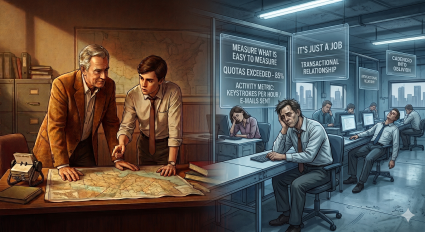
Over the past few weeks, I’ve had the same conversation, with a number of old-timers in business and sales. People who’ve been doing this for thirty-forty years. The conversation always arrives at the same conclusion. People don’t seem to care anymore. They don’t have the drive. They don’t have the joy. It’s just a job, where for us it was a passion, a calling, something we threw ourselves into. What happened?
Something has shifted, and the people noticing it aren’t imagining it. But the diagnosis many of us are reaching for, “kids today don’t have what we had,” may misread what’s actually happening. Until we get the diagnosis right, everything we do to “re-engage the workforce” will fail. And too many of our organizations are failing. They’ve been failing for a decade. The engagement scores keep dropping, voluntary attrition is rising, but we continue to be shocked at what’s happening.
As I reflected on the conversations I’ve been having, I realized I was missing something about my own experience and the experiences many of the “old farts,” shared with me. What we forget is that we are the ones who stayed and thrived. We are the survivors. We’ve forgotten about the colleagues who burned out, washed out, hated the job, got pushed out, or quietly checked out twenty years before retirement.
Those of us “still standing,” remember passion. It’s that passion that separated us from many of our peers, it’s why we are still standing. When we reflect on the old days, we remember our own experience, forgetting our peers that checked out or left for other jobs.
When we compare those memories to what we see today, the comparison is inaccurate because we are looking at only our experience. We aren’t being honest, because we have forgotten about our colleagues who didn’t have the passion we had. Those that just did the job, put in the hours, and looked for something outside the job.
In these comparisons, we were the ones that thrived, despite what was happening at the time. But we are inaccurately applying that to a whole generation and then comparing it to the current generations. As a result, we miss the fact that many of our older colleagues did not have the same passion and excitement we had. And when we criticize current generations for that lack of passion and excitement, we are being unfair.
Having confessed this, there is something genuinely different about the old days and today. Much of what I experienced in the old days was essentially cultural. I started my career in IBM. It was known for a very tough culture, one that caused me to thrive, but I forget the many colleagues who disliked that culture and left for other things. This didn’t alter the work itself or the path through it. The work was still the work. The apprenticeship was still the apprenticeship. The rewards at the end of a long career were still real. And it was meaningful for me.
What’s happening now is different. We are watching the simultaneous breakdown of every system that produced the old-timers’ passion in the first place. Not just one aspect of that work, we are seeing the breakdown of everything, all at once.
The first breakdown is the implicit contract with the organizations we worked for. Old-timers entered organizations that offered tenure, pensions, real training and development, actual mentorship, defined career paths, and the unstated assumption that if you did your job and didn’t embarrass anyone, you’d still be there in twenty years. In return, employees gave loyalty and strong effort.
At the time I entered the workforce, people generally worked for one or two companies for their entire career. It’s different today!
Today, that “contract” has been dismantled. Every layoff cycle, every cancelled training program, every “we’re in this together” speech delivered three months before the RIF, every role that is outsourced or “gigified” with contract employees, or now replaced with AI. These break the “contract” that seemed to indicate that people are important. And everyone sees this in their own company and in companies all around them.
Today’s workers are not lazy. They are, however, rationally calibrating their commitment and effort to the “commitment” they see from the organizations they work for. These organizations have created a transactional relationship, as a result, their employees don’t display the same commitment we old timers saw years ago. “It’s just a job” is exactly the response executives of current organizations should expect when they have no commitment to the people doing the work.
In sales specifically, the parts of the work that produced joy have been deliberately engineered out. The old salesperson had territory, time to learn about the customer, real ownership of the relationship, the freedom to think. They had the time, resources, and support to find, manage, and close deals, achieving their quotas. When faced with roadblocks, they were supported in figuring things out.
Today’s salesperson is cadenced into oblivion. The only thing that counts are the activity metrics. Every interaction is scripted. They are fed sequences and measured on call counts and email opens. The craft has been stripped out in the name of efficiency.
You cannot extract meaning from work and then be surprised when people do not find meaning in it.
We have done this to ourselves. We measure what is easy to measure, optimize what is easy to optimize, and in the process, we have eliminated the parts of the job that made it a job worth doing. Goodhart’s Law in action.
Then there is the financial math which is different. In the early ’80s, I was making about $250K. Adjusted for inflation, today that’s over $1M. In the old days, we could buy a house, raise a family, put kids through school, and retire.
Today’s seller doing the same job for the same inflation-adjusted income cannot do any of those things. While we read of people with 7 figure incomes, the majority of sellers earn less than 25% of that. The reward at the end of “work hard and be patient” has been lost. People aren’t stupid. When the deal at the end of the road no longer pays, they shift to something else.
Add to this the visibility of bad corporate behavior, which is genuinely new. Old-timers could believe their company was loyal because they couldn’t see the contradicting data. The CEO’s pay package was not on LinkedIn. The layoff numbers from companies were not in your feed. The, “we’re in this together,” along with the RIF were not posted side-by-side by a former employee with screenshots. Today’s worker can see, in real time, the entire pattern of corporate behavior across an industry. They are not cynics. They are well-informed.
Then there is the collapse of the meaning frameworks that used to surround work. Community, family, civic institutions, church and others helped create meaning in people’s lives, with work being part of that.
As many of these structures have been displaced by Facebook, Instagram, Tik Tok, LinkedIn, Twitter/X, work now has to carry a weight of human engagement that it has never been designed to do. Yet at the same time, we are stripping many of those things that helped create meaning out of the work itself. Expecting work to be everything while, at the same time, making it less is a contradiction nobody can sustain. And the natural response is that people withdraw.
And now AI is amplifying all these factors. It is eliminating the apprenticeship that built the old-timers, like me, in the first place. The passion I have came from being shaped, struggling with a hard account, getting coached through a loss, learning a market by working it for years, being mentored by someone who actually cared about my development.
Today’s entry-level seller misses all of that and is handed AI-generated talk tracks, AI-summarized accounts, AI-drafted emails. You do not develop a passion for work you never actually get to do. You do not fall in love with a profession you never actually learn. The workplace that produced these old-timers who wonder about the lack of passion is being undone. But we still expect the same passion and excitement we old-timers remembered.
There’s another challenge. When I entered the workforce, I had the advantage of having many old-timers there to coach, mentor, and develop me. Teammates, with years of experience shaped me, even as I may have resisted it. The war stories, discussions over a beer, the ability to ask them for advice were important to me.
But today, those old-timers are no longer there. Many have been forced out, being replaced by less expensive people, with no experience, but supported by AI. The people that were so important in shaping me and my career are no longer available to shape the careers and attitudes of the current generations.
When I reflect on the passion I have developed and see the same in many of my old-timer peers, I’m driven by the question, “How do we re-engage people today?”
Sometimes, I think of it as a leadership challenge. What do leaders have to do to reshape the worker experience? That is important, but there is more to it.
We don’t re-engage people through engagement surveys, culture workshops, town halls, recognition programs. We don’t reengage them by redesigning our workspaces, free coffee and snack bars, and free beer busts.
People are re-engaged when the conditions that produced disengagement are reversed. There is no shortcut. There is no initiative. You rebuild the apprenticeship, you honor judgment, you make the contract honest. If you are a transactional employer, pay like one and stop demanding loyalty. If that produces the long term results you want, then that’s who you are, as an organization.
But if you want loyalty, earn it by being loyal first. If you want engagement, you have to be engaged first. If you want people that care, you have to care about your people. You measure outcomes that matter instead of activities that do not. You let your people think.
When I reflect on my career, I developed passion because my leaders had passion, for our craft, our customers, for the people they were developing. Today’s leaders are passionate about quarterly numbers, AI transformation announcements, headcount efficiency, and their own next move.
Workers mirror what is modeled. If the people at the top are visibly transactional, visibly short-term, visibly indifferent to the actual work and the actual customer, the people below them will be too. Disengagement is contagious, and it starts at the top. This is the way it’s always been.
Here’s my thinking about the questions, “how do we re-engage them.” Most organizations will not. They will run another survey, launch another platform, hire another Chief People Officer, announce another corporate values refresh, but things won’t change.
For the few that genuinely care, they focus on restoring craft, creating real mentorship, honoring judgment, having leaders who actually care about the work and the people doing it; these will discover their people have always had the passion and drive, they just needed to create the conditions that enabled this.
Old-timers, like me, are right that something has gone missing. But we are wrong in thinking that the new generations are different. The reason we don’t see the passion and engagement that drove us is the conditions that created this have been withdrawn. They have been deliberately eliminated for efficiency. The reactions we see in the current generation of workers is a rational response to the priorities and actions of organizational leadership.
When employers strip the meaning out of work, the people will respond looking for meaning in other places. When we wonder about what’s happened to the current generation, we should be wondering, “what did we do to create what we see?” And if we don’t like what we see, we must ask ourselves, “Are we willing to change it?”
Afterword: Another fascinating AI generated discussion of this article. There are a few small errors but these don’t detract from the quality of the discussion. Enjoy!

