In “Is Good Enough Good Enough,” I introduced the fundamental mindsets and behaviors for sales excellence. What do these have to do with developing our judgment?
In some sense, it’s a chicken and egg discussion. Our mindsets and behaviors impact our judgment, and our judgments impact our mindsets and behaviors. It constantly runs both ways.
For people who haven’t read the book or this whole series, let me lay some groundwork for this discussion.
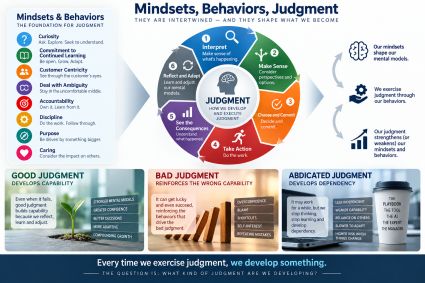
The book established 8 mindsets and behaviors critical to excellence. These were: Curiosity, commitment to continued learning, customer centricity, ability to deal with ambiguity/uncertainty, accountability, discipline, purpose and caring.
The mindsets are the underlying mental models and value systems each of us holds. The behaviors represent our execution. These underlie everything we do, the absence of any one of them impacts our ability to achieve our full potential. Without discipline, we wander. Without curiosity, we are stuck with outdated views. Without accountability, we tend to blame others.
While each behavior is always at play, some dominate at certain times. In a discovery call with customers, curiosity and customer centricity are at play. In trying to develop a strategy to handle a very complex account, customer centricity and the ability to deal with ambiguity come into play. In a forecast review, discipline and accountability dominate. In engaging customers and developing trust, or a manager working with their team, caring and purpose may dominate.
Now let’s look at judgment. In the first post, I developed a model for developing and executing judgment.

You can begin to see how both of these models mesh with each other. Our mindsets form our mental models. As we confront a situation, our interpretation is based on our models. Here you see curiosity, customer centricity, or ability to deal with complexity at play. We make choices, commit, and act. Those are acts of discipline and purpose. We realize the consequences of those actions, accountability. We reflect on the outcomes, accountability and continued learning and we adjust our mental models based on this.
It’s easy to see how closely intertwined these are. We can’t develop our judgment without using and developing the underlying behaviors critical to excellence.
What happens when a behavior is missing? Our judgment suffers.
Without curiosity, it is impossible to interpret and make sense of a situation. We are stuck with doing what we’ve always done, even if it’s the wrong thing.
Without accountability or discipline, we can never understand the consequences or reflect on what happened. As a result, we continue to make the same mistakes.
Without purpose or accountability, committing reverts to compliance or paralysis.
Yeah, I know you’re still scratching your heads.
You get the interconnection between these, but again, “So what?”
We continually exercise judgment, regardless of how well developed these behaviors are.
Without curiosity, we stop interpreting, we just use what we already have learned or believe. Even though it isn’t working.
Without customer centricity, our committing and actions focus on our interests and not those of the customer.
Without discipline, we aren’t committing and taking the actions necessary. We aren’t doing the work.
Without accountability, we learn nothing from the results we produce.
Without caring, we can exercise rational judgment but create an outcome that damages others.
We are always exercising judgment. It could be good, bad, or delegated.
Delegated judgment seems to be dominant. Delegated judgment isn’t necessarily bad. We rely on experts, systems, processes, tools, AI, and other people when they are helpful. But when delegated judgment becomes surrendering our reasoning and thinking, it becomes abdication.
We stop looking at whether the answer fits, whether things are working. We stop challenging the process or playbook. We stop learning and thinking, no longer take the time to figure things out.
Delegation becomes abdication when we let someone or something else decide and we just execute.
Abdicated judgment isn’t bad judgment, it’s surrendering our judgment. Bad judgment is where we exercise it ourselves, but poorly.
People rarely know their judgment is bad. The missing or poorly developed behaviors that would have caught the problem have not been developed. Curiosity and customer centricity might have shown them they were exercising bad judgment. Lack of accountability blinds them from owning the bad judgment.
More dangerous, sometimes, we just get lucky, despite our bad judgment. We never think it is luck; we think it was our judgment. And the things that drove bad judgment are reinforced, including the behaviors behind it.
But luck isn’t forever. Bad judgment catches up to us. Unfortunately, through this process, we’ve reinforced the mindsets and behaviors underlying those bad judgments. We fail to see what we must do to change.
Whether it’s delegated or bad judgment, we aren’t building the behaviors necessary to develop good judgment. We fail to change when change is most critical.
So, nothing changes, when change is most critical.
Which brings us to good judgment.
Sometimes when we are doing the best we can, when we are leveraging the behaviors that drive good judgment, we fail. But the people exercising the judgment own the failure, they own the accountability. Their curiosity drives them to understand what went wrong, to look at what they might change, to shift their mental models based on what they learned.
Bad judgment can be rewarded by luck, reinforcing the wrong behaviors. Good judgment can fail but still strengthen the right ones.
Outcomes don’t tell you what kind of judgment you are exercising. A delegated judgment can succeed. We’ve seen it for years in delegating our judgment to scripts and playbooks. And we see that success is not sustainable. Bad judgment can get lucky. A good judgment can fail.
Bad judgment can succeed and make us worse.
Good judgment can fail and drive us to improve.
What distinguishes each is the reasoning and behaviors underlying the judgment.
And this is what we miss too often. We focus on outcomes, but those outcomes tell you very little about the judgment exercised to create those outcomes. We’ve walked through how delegated, bad, and good judgment can each create good or bad outcomes. It’s only when we examine the reasoning that produced the outcome that we learn and develop. Was it luck? Was it sound reasoning that for various reasons did not hit?
As leaders develop our people’s judgment, it requires looking at the reasoning, the behaviors that created the outcome. For individuals reflecting on an outcome, it’s thinking critically about decisions made, execution and what was learned.
All of this brings us back to the chicken and egg. Behaviors and judgment.
We’ve gone through how tightly connected behaviors and judgment are. Our behaviors shape our judgment; our judgment impacts our mindsets and behaviors.
Every time we exercise judgment, we develop something.
Good judgment develops our capacity to improve. We do this when we exercise curiosity, customer centricity, accountability, discipline, caring and the other behaviors. We reflect on experience and change. Our mental models improve.
Bad judgment with a lucky outcome reinforces those things that produced bad judgment. We fail to recognize it was luck. But luck reinforces the development of the things we should be changing. We continue to develop those things, despite the failure.
Delegated/Abdicated judgment develops something else: dependency. We become better at following the script or playbook. We are dependent on the dashboards, on what our managers or AI tell us. At the same time, we lose the ability to figure things out.
While it may be faster and more efficient, it fails when things change. And we learn that we have not developed the capabilities to respond to that change.
We are always developing something when we exercise judgment. The critical issue is whether we are developing capabilities and behaviors enabling us to learn, grow, achieve.
Developing judgment takes time. It takes reflected experience. Curiosity takes time, learning takes time. Struggling with ambiguity and developing discipline takes time. Thinking and figuring things out, rather than following the script takes time.
Experience alone doesn’t develop judgment. We can repeat the same things for years and not learn anything.
It’s reflected experience, thinking about what has happened, why, what we might have changed, that develops judgement.
There are those who don’t take the time. It may be the constant press of activities; they don’t take the time to reflect. It may be the lack of support within the organization. They exercise their bad judgment because it solves today’s problem, or it is easier to do. They delegate their judgment because it’s easier than learning for themselves.
Developing judgment comes with a price.
But the alternative has a far greater price.
When we remove the ability to think, question, interpret, choose, act, reflect and learn, we are eroding our ability to deal with what we face tomorrow.
And that’s the real problem. Customers change. Markets change. So do competitors and products. Our strategies and playbooks stop working, AI gives us answers that no longer work.
We face something we’ve never seen before, and we lack the very skills and experience critical to figuring it out.
Judgment is always there.
The question is “What are you doing to develop your good judgment?”
Afterword: This AI generated discussion of the post is intriguing. In the first 4 minutes, I wondered whether they were really understanding the mindsets and behaviors. They provide a layoff example, where they don’t quite understand. But what I found amazing with this, is the errors caused me to listen more closely, I was more engaged. Hope you find this interesting too.

