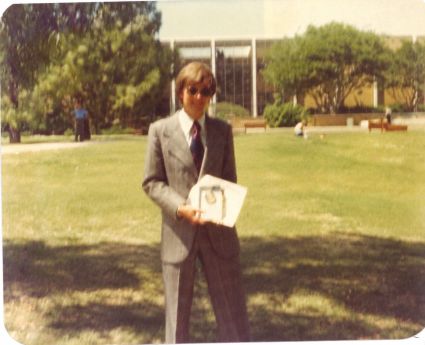
Yes, that picture is me. Just got awarded my MBA at UCLA. A week later I was in Manhattan, starting my job at IBM.
I was, and still am, awkward. A slightly nerdy guy. In the evenings I started doing what every single man in Manhattan did. I started hanging about in bars, hoping to meet women.
As I walked to a bar, I’d be thinking of ways to proposition women I would encounter. I’d come up with lines. Brilliant things like:
“Hey girl, I work for big Blue, but you won’t be blue with me…”
“My customer is Chase Manhattan, I hope I don’t have to Chase you in Manhattan….”
“Want to tabulate together…..”
I’m still just as awkward. I was so bad a group of women in the office started trying to set me up with women. But that’s another story.
You can see the problem with my Propositions. They were driven by my interests and had nothing to do with what the women I was trying to engage might have even been interested in. I struggled to engage them in conversations to discover that interest.
Let me jump to how we talk about our Value Propositions. Sometimes, I think we are just as awkward. We hope to present an exciting line, perhaps a chart, or reference that will convince our customers we’re the one.
Our customers are, also, “courting,” several other, perhaps hotter competitors. But we think if we have just the right line, we will win their hearts, at least to move them to qualified.
But like my propositions, are Value Propositions usually have very little to do with them, their problem and what they care about.
Let me go back to my dating challenges. With the help of some women in my office, I learned how to have a conversation with the women I encountered. I learned to ask them about what they did, not just at work but outside. Things they had fun doing, favorite restaurants, plays, rock groups. I had just started playing squash and many had a similar interest.
And through that process they learned about me. We started talking about doing things together. Perhaps a squash game after work and dinner. Perhaps a ferry boat ride around Manhattan. OMG!! I might actually get a date!
What I learned in the process, was my Propositions were meaningless. They had heard them from too many others (though I think mine were a little more imaginative.) But taking the time to get to know them, and in that process, they got to know me, enabled us to build a relationship.
Working with our customers is not that different. It’s really a process of getting to know them, what they are concerned about, what they are trying to do, the risks, rewards, challenges.
But as in dating, it needs to go deeper. It’s sitting beside the person and asking. “How do these 3-month delays in your supply chain impact your ability to hit your manufacturing commitments? What is this costing you?”
Or, in a different situation, “I’m seeing this as I look at your pipelines. How is it impacting your win rates? What does it mean to hitting your numbers?”
In this process, we better understand them, and they get to know us. Not just at a surface level, but in ways that become important to them and to us. And we begin building something important to all relationships, trust.
I actually used a variant of the, “How do these 3 month delays…” question in a 30 minute conversation with a CFO. At the end of that conversation, we discovered it was costing the organization $22B a year! (This was a monstrous corporation with revenues well in excess of $100B.) The client had been working with his people for over a year, gotten their support for their software tool, but couldn’t close the deal.
The problem was my client didn’t understand what the customer really cared about. And they weren’t talking to the people that were experiencing the problem. After the 30-minute conversation, the CFO turned to my client and asked, “How can you help?”
The second case is about me and how I helped a customer think differently. They were a very good sales organization. They had high win rates, were hitting their numbers, but were struggling to grow. It turned out they were so busy handling transactional business, they didn’t have the time to sit down and engage their customers in understanding and helping them understand their business.
I asked about their pipelines, but what I was really doing was helping them explore new growth strategies. In the end, we rearranged their territories, found a new way to handle the transaction business. We did some development of the field teams. Within 9 months, their average deal value went from $10K to $190K. In 3 years, it was $1.5M and their win rate had increased 45%.
I helped them see something they might never seen otherwise.
We’ve made Value Propositions the pick-up lines for the B2B sales. Our competitors are using the same pick-up lines. And, just like in the bars, no one wants to talk to us.
We so often miss the opportunity to help our customers think about things differently.
I was a heavy rocker. A woman I was dating introduced me to Pat Metheny. I found a whole new genre of music that captivated me. She helped me discover something I would have never thought about. One in which she had deep understanding. Soon I found myself mixing rock and modern jazz in my concert adventures. We discovered music together.
Value creation is the process of understanding our customers, each person involved in the organization, and collectively. It’s about understanding their challenges, dreams, and problems. It’s about helping them think differently about their businesses.
Just as with dating, it’s not something we do to them, it’s something we do with them.
But doing this requires more than ponying up for another round of drinks. It takes time and commitment. Not an enormous amount of time, but the willingness to sit, engage and understand. And that takes commitment and caring.
Too many will say, “We don’t have the time!” Look back at the two references I made. One was done in 30 minutes. In the other, the organization was losing millions in opportunity because they couldn’t see the opportunity until they took the time to understand.
“We don’t have the time,” is no longer a defensible excuse. Particularly, when your win rates and results are plunging and your customers don’t want to talk to you.
You have a choice.
You can be the one that starts the conversation making it about the customer and learning about them.
Or there’s always: “Hey there, our software tool is AI-ing you!”
Afterword: This AI discussion of this post is actually quite embarrassing. Imagine AI characters commenting on your dating approaches and pick up lines! Enjoy! Please laugh with me, not at me 😉

