Over the past months, I’ve been obsessed with writing about judgment. Whether it is what AI leaves to humans. Or that leaders exercise in developing their teams. Or the judgment an individual exercises in the moment of engagement with a customer.
Judgment is the differentiator in how we get things done when uncertainty and risk exists.
After all these posts, I realized I’ve talked about the word but never spent any time talking about what judgement is.
First, I did something unusual, I went to the dictionaries:
· Cambridge Dictionary: the ability to make decisions or to make good decisions, or the act of developing an opinion, esp. after careful thought. (I’m not completely in agreement with this, we use judgment but make bad decisions, more later.)
· Merriam Webster: a: an opinion or decision that is based on careful thought. b: the act or process of forming an opinion or making a decision after careful thought : the act of judging something or someone.
· Collins: 1. A judgment is an opinion that you have or express after thinking carefully about something. 2. Judgment is the ability to make sensible guesses about a situation or sensible decisions about what to do. 3. A judgment is a decision made by a judge or by a court of law.
Then I went to my friend, Tom Morris. “In most other contexts, and from a philosophical point of view, judgment is something like the ability of discernment, a capacity to assess, interpret, and conclude. Is something true, or beautiful, or good, or proper? Judgement is the ability we have to answer such questions. It is a cultivated sense of reality, as distinct from appearance. It is of course not infallible, but can grow in its perspicacity.”
Reread Tom’s definition a few times, there is so much important buried in it. I will leave you to dissect it yourself.
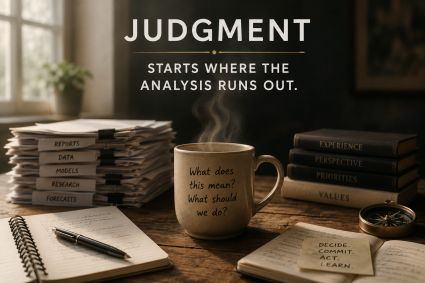
My own definition: Judgment starts where the analysis runs out.
In selling and most of business, there are seldom definitive answers. We can never say, “This call will produce this result.” or “we will win the deal 100% of the time when we do these things.” As much as our analysis tries to give us the answers, there is always uncertainty.
Analysis only informs judgment. It doesn’t produce judgment. Analysis can only tell us what has happened. It can identify patterns and correlations. It can summarize past history.
But eventually, someone has to decide. What matters, what it means, what we are going to do. This is where judgment starts.
Judgment involves a number of things. I’ve attempted to put together a model. I’ll do a deep dive into each element.

Every decision we make is based our Mental Models. Things we’ve learned, experiences we’ve had, biases we’ve created. Our mental models are also guided by our purpose, both individual and organizational. Judgment cannot exist without a deep understanding of what you are trying to accomplish. The simple example is “How do I know whether I am exercising good or bad judgment?” Purpose provides the context and framing for every decision we make.
These mental models influence how we Interpret each situation.
As we seek to Make Sense of a situation, we look to understand what is known and what is assumed. We look to understand what matters and what doesn’t. We realize there may be multiple explanations for the same thing. We recognize the limits of our own experience and actively seek other views. We know when our past experience applies and where this situation might be different. All these contribute to our interpretation of the situation, leading us to committing to a decision or plan of action.
As we make sense of the situation we make Choices. We always make choices, some may be unconscious, some may be defaulting to what we have always done, some may be to do something different. They are choices.
As we look to Committing under uncertainty, we need to understand the tradeoffs and consequences. We recognize that we have to make a commitment, despite the uncertainty. We have to understand if what we are doing is good, proper, and ethical. Committing results in taking action.
Actions are the things we do, based on everything that got us to this place. They are the visible things that we do. We’ve committed to a strategy, our actions are the how we demonstrate the strategy. We’ve committed to certain levels of performance, or activities, the actions are the manifestation of those things.
These actions we take have Consequences. Those may be good or bad. We may have succeeded or failed.
These consequences may be a result of the quality of the judgment, or the quality of the execution. We can make an excellent choice, but the actions we took did not produce the expected result. Or we can have a terrible idea, and execute it flawlessly.
As we see the consequences of our actions, we must be open to being wrong. We have to be willing to change when the reality we see is different. Rather than defending our decisions, we have to learn from them.
We mistake “getting the right answer,” with good judgment. As I’ve mentioned, we exercise the best judgment we can, yet as circumstances change we realize a bad outcome. And sometimes, we just get lucky, we’ve exercised bad judgment and got a great outcome.
This is, possibly, where we don’t pay sufficient attention, and creates the biggest danger We judge the decisions based on the results. Yet too often, we fail to understand what produced those results. If we won, we don’t examine anything. Did we win because we did the right things, based on the judgment we exercised? Did we win because we were lucky? Likewise when we look at losses, do we revert to assigning blame or defending what we did? A good result doesn’t confirm good judgment. A bad result doesn’t disprove it.
If we evaluate judgment on the basis of outcomes, we may actually be training ourselves to exercise bad judgment.
Examining the consequences moves quickly into Reflection. And it is probably the thing that has the greatest impact on everything we do. Reflection is the mechanism through which we modify our mental models.
We think experience builds judgment. It’s really reflected on experience builds judgment. Two people with the same experience will have completely different levels of judgment. One can look at a deal and say, “I followed all the steps.” Another can say, “I realized that I hadn’t addressed the perceived risks adequately. While I developed a plan that addressed the risks in the project implementation and they could realize value, I didn’t understand the risks individuals critical to the decision were dealing with.
Same experience, similar lost deals, completely different levels of reflection, exercise and development of judgment. The first will keep following the steps. The second will be more careful in understanding the risks each person involved in a deal perceives.
Experience doesn’t teach us, it’s the reflection on those experiences where the learning takes place and judgment develops.
The unfortunate reality is we don’t take the time to reflect. We won or we lost, but moved on. Something worked or didn’t, we kept doing it. We accept the results, good or bad, and just move on. Did we assess it correctly? Did it fit our past experiences, if it didn’t how did we deal with it? What drove us to the choices we made? Did we execute well? Did we miss something. Where were we right, where were we wrong, what would we do differently.
It’s this reflection that informs and builds our mental models.
And this brings me back to purpose. I started this discussion talking about how purpose is critical to developing our mental models. Purpose guides us through the cycle. And our purpose can be challenged in this process. And we have to periodically reflect, adjusting our purpose, consequently our models to more effectively achieve that purpose.
This is a never ending cycle, but one that cannot be done unconsciously. If we do move unconsciously, we are actually making our judgment worse.
But now we have a new factor at play, AI.
We are tempted to say, “AI threatens human judgment!” Others will claim, “AI cannot exercise judgment!” But these are meaningless and don’t help us understand the role, contribution, and limitations or dangers of AI.
Let’s go back to our model and look at how AI might play in each aspect of the model. As you might expect, it can be used with great power and it can be used very poorly.
Starting with Mental Models. AI can help us broaden them. We can use AI to challenge our thinking. As we look at our experiences, things we’ve learned, things that may bias us, or reexamining our purpose. AI can challenge that thinking. It can help us see perspectives we may not have otherwise seen. It may help us generate ideas that would have been impossible without it. It can help us stress test our thinking, ask different questions, and arrive at new conclusions.
Alternatively, it can substitute it’s own models and approaches for ours.
As we look at Interpretation and Making Sense, AI can help expose and challenge assumptions. Provide alternative explanations, see things beyond our experience, consider changes we may not have otherwise done.
Or it can do those things for us, giving us the same answers as it might be giving our competitors.
As we look at Choice and Committing, AI can help us develop alternatives. It can red-team our thinking, help us see something we might have missed.
Or it can tell us what to do.
On Action, AI can help us improve the thinking and execution of the actions we take. Or it can choose to execute these without our involvement. The question isn’t about how much we can automate or delegate to agents, it’s how much of our judgment cycle are we willing to have it do without us.
Consequences, AI can help us analyze and understand what happened. It can tell us execution failures. It can help us assess whether our original judgment was sound, but it can’t tell us authoritatively. That afterall is a judgment call.
Reflection, AI as a debate partner, helping us think about things differently, reevaluate what we should be doing can be very powerful. Or we can just continue to do what we have always done and AI can do that work, often better than us. Even though it may be the wrong thing.
As we look at the whole cycle, AI can help amplify our thinking, it can expose our blindspots, understand things differently, provoke us to develop new answers and different approaches. In this process it can help accelerate the cycles through which we develop our judgment.
Or it can do the work for us, removing the experience and critical thinking necessary to build judgment.
The question we must pose for ourselves, individually or organizationally. Do we want to have AI help build our capabilities? Or do I want to have AI do the work for me?
In answering these questions about how we leverage AI, we are exploring our own behaviors in curiosity, continued learning, customer centricity, ability to manage change/understand risk, discipline, accountability, purpose and, ultimately, do we care?
You may recognize these as the fundamental mindsets and behaviors I wrote about in Is Good Enough Good Enough.
You will recognize these aren’t just the choices that influence how we use AI. They are the choices we make in how we work, learn, and grow. And it’s in these choices we build our experience and we develop judgment.
We don’t choose whether to exercise judgment. It is always there. You can only choose whether you want to get better at it.
You can seek to continue to develop your judgment, or you can surrender it to others including AI.
If you are doing very routine, highly predictable, low risk work, you may not have to develop your judgment. You can follow the scripts, check the boxes, and let AI do much, if not all the work for you.
If you are in an environment driven by constant change, ambiguity, uncertainty, high risk and the consequence of failure might be high, the quality of your judgment matters more.
Ultimately, what we are talking about is choice.
We choose what matters.
We choose how to interpret.
We choose among alternatives.
We commit to those choices, acting on them.
We choose how to respond to the consequences.
We choose how we reflect and learn from our experiences.
We choose whether we need to change our mental models.
Ultimately, we choose whether developing our judgment matters to us at all.
Afterword: This is such a complex post and covers so much. I was worried how these AI characters would deal with it. The discussion is fascinating. I do have a problem with their characterization of the process of developing judgment as a “machine.” But as I listened further, I understood how they were using it. It’s a brilliant conversation. Enjoy!

