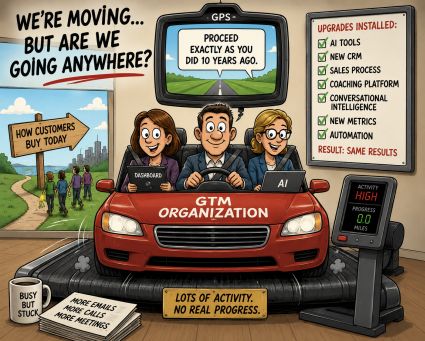
The whole purpose of every GTM organization is to convince our customers to change. Whether it’s a new way of doing things, an ability to address a new opportunity, or replacing what they currently use with our own products.
Everything we do is oriented around helping our customers challenge the status quo, build the case for action, create urgency, manage risk, develop confidence in their change initiative.
Yet when we go back to our own organizations, we continue to do things the same way we always have done them. The same approach to market, the same emails, the same calls, the same metrics, the same org structure, training programs, processes. What we do today, is, largely, what we did five years ago, ten years ago….
Some of you may argue, “Dave, we are changing constantly! How can you say this?” The majority of the change I see is what I call “change as theater.”
We shuffle our org charts, we change our process, we adopt a new methodology. We have new metrics and dashboards. We leverage technology, and today, we leverage AI.
But when you dig in, rarely has anything changed. We continue to send emails, only more. AI has removed that limitation, so we continue to do what we always did with no upper bounds. Same with calls, demos, any other outreach. We have dashboards that give us more information than we’ve ever seen before, but we still don’t understand what they mean and go back to the dials and charts we always used.
There is no end to new methodologies, processes, technologies, that we overlay on what we currently do. We have conversational intelligence, coaching us on each call, but our customers don’t want to have conversations with us.
With technology and AI, all we do is automate a faster version of what we have always done. Our spray and pray strategies have now shifted to spray faster and pray harder.
I want to be careful in this discussion. Most organizations aren’t dumb. I see very talented people in virtually every organization I encounter—-OK, OK, there are a few really dumb ones out there, but they are rare.
The problem isn’t that we don’t have smart, well-intended people. The problem is we are trapped.
We are consumed in the day to day. Measured on activity data and current quarter forecasts. Our incentive systems reward the same things they have always rewarded, so change often doesn’t fit those models.
And sometimes real change is a problem, often in the change, things get worse before they get better. It takes us time to understand, implement, and make the change. It takes mistakes to understand what works and what doesn’t work in the change.
Resistance to change isn’t a character flaw, it’s rational behavior in a broken system.
Everyday, we talk about how customer buying behavior changes. They want to minimize rep involvement. They prefer digital buying journeys, yet our websites remain the same. With the same download, case studies. They look other places for information, but we don’t help them connect with others who have the same problem.
We see more people involved in the buying process, yet we focus efforts on the same people and roles we have always worked with. We see buying processes lengthening, and more ending in no decision made, yet our strategy for responding continues to be, “I can give you a discount if you sign this month!”
In spite of all of this, we keep on keeping on.
And it isn’t working.
What if we dug into how the market really buys, then we are focusing on real change, not change for change’s sake.
What if we challenged ourselves to look at how the market actually buys? In understanding this, working on this, we’d avoid change for change’s sake, shifting to change that responds to the way our customers are changing?
What if we recognize that we resist change for the very same reasons our customers do? The status quo seems safe.
What if we could use our own experience in change in our conversations with customers? Think of the empathy, that results from, “we’ve gone through similar things?”
The only constant in our world is change. It impacts our customers; it impacts each of us. We cannot expect our customers to change unless we have changed ourselves first. We cannot help our customers understand and manage change, unless we have experienced it ourselves.
What are you changing?
Afterword: A fascinating AI driven discussion of this post. Enjoy!

