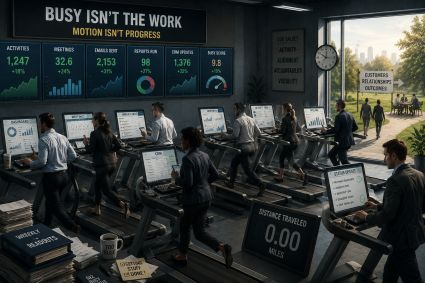
We tend to treat performance problems as knowledge problems. If the results are disappointing, surely the people don’t know what to do. So we train them again. We send them to another workshop, build another playbook, roll out another methodology, buy another tool. And then we are puzzled when nothing changes.
But walk into almost any team that is struggling and ask the people what they should be doing. They will tell you. They know they should keep the CRM current. They know they should qualify against the ICP rather than chasing anything that moves. They know the difference between selling and pitching. They know that reacting to inbound noise all day is not the same as the deliberate, proactive work that actually builds a pipeline. They can recite all of it back to you, chapter and verse.
They just aren’t doing it.
The performance gap we see so often is the gap between knowing and doing. And it’s probably the most expensive gap we see in organizations.
What makes it so difficult to see is people aren’t just sitting around. They are incredibly busy. Calendars are filled with meetings and activities. Inboxes overflow. We don’t have enough time in the day, even when we stretch the hours worked each day. We are surrounded by constant motion. But motion isn’t work, and being busy doesn’t produce results.
We see this in too many sellers, but the issue isn’t just with them. It permeates all levels of the organization. Front line managers know their real work should be in coaching and developing their people, helping them get things done both with their customers and within the organization. They know they need to sit down with their people reviewing deals, pipelines, forecasts, account strategies, not just for status but to help in developing the appropriate action plans. They know how important it is to have the tough conversations that help drive development.
But instead, the time is spent paging through CRM, studying dashboard after dashboard. Weekly planning goes out the window as managers shift into react-respond mode, moving from crisis to crisis.
But the problem doesn’t stop there, senior managers face the same issue, spending time looking at endless reports, robbing them of the time they might spend in the field where the work is being done. Calendars fill with reviews, but then are disrupted by crisis escalation. What started as a well planned week becomes a fire drill.
And we see the same things permeating the support organizations; operations, enablement, deal desks, marketing and others.
For everyone, readouts, dashboards and data become a surrogate for understanding. The resulting actions are driven by the data, not by involvement where the work is actually being done. At every level, across the organization the substantive work is being replaced by efforts that are easier and more visible to everyone else. Activities become performance art not performance.
Watching the work, reading the reports, analyzing data is not the real work, but it has become what appears to be work.
We look at each lapse, taken individually they seem OK. CRM is not updated because the day got away from us and we didn’t have time. We chase a deal outside the ICP because it was there, it looked good and a deal is a deal. We shortcut qualification, because we think we know the answers, and rather than doing discovery we rush to the pitch. Coaching meetings and deal reviews are postponed because we are called into a forecast meeting because things aren’t going well.
Any of these things can and does happen to each of us. But they are not isolated events. They become the patterns that describe every day, every week. We take shortcuts, we skip the real work, we don’t take the time to do what we know we should be doing, substituting reacting for the real work.
And this accumulates across individuals and every corner of the organization. Incredibly busy people, filling their days with activities, crowding out the activities that most drive performance. And at the end of each day, everyone is exhausted and drained.
Unconsciously, busyness and activity become the work and the center of focus. The busyness feels like effort. At the end of the day, we are genuinely tired. We reflect on the volume of activities, pleased at how much work we did. Since this has become the work, we start measuring and tracking it. And the dashboards confirm the activities, reinforcing our thinking about these activities representing the work.
But at some point it hits us. Despite the activities and how filled our calendars are, we aren’t producing the outcomes needed. We’ve missed the numbers for the month or quarter. We see our win rates decline. When we really study our pipelines, we see that we won’t make the numbers in the coming month or quarter.
We slowly realize the activities were just activities and what seemed like work actually isn’t the real work. But too often, we reach for the wrong solution. We double down, more activities. We leverage technologies that help us get those activities done at a higher volume. We are busier than ever yet nothing changes.
We go through the same cycles, until at some point, we recognize our diagnoses have been wrong. The work isn’t about the activities. The work is that which creates the necessary outcomes.
Now, two very different things are going on that create this cycle of misunderstanding.
The first is, some people simply will not do the work they know is required. They have decided the effort isn’t worth it and do the minimum. And, often, they get by. Everyone else is too busy to notice or good enough becomes good enough. No amount of coaching and encouragement will fix this. What we are seeing is an accountability and fit problem. Correcting this calls for very direct, tough conversations.
But they are the minority. Far more common are the capable, conscientious, well-intentioned people, individual contributors and leaders alike, who never decided to stop doing the work. They drifted. The urgency, activity, and the react/respond mode crowded out the real work. One day at a time, the real work was displaced by activity and shortcuts.
As I’ve highlighted, over time, these accumulated until shortcuts and going through the motions slowly became the normal way of operating. No one consciously chose this. They gradually fell into it.
But the encouraging part is that what we unconsciously fall into, we can climb back out of.
Take a moment. If this latter case represents how you are working, and if we are honest, at some point all of us slip into this operational mode. There are three things worth doing to correct it.
First, take some time to audit how you are currently spending your time. Look at what you had planned to do last week and look at what actually happened, where you really spent your time. What percent of your time was diverted by some crisis or just the react/respond mechanism? What percent of the time was spent actually doing the work that produces outcomes, rather than talking about it or reviewing data about it? What percent of your time did you spend pursuing activity goals versus pursuing outcome goals? Be honest, don’t be surprised if you find the majority of your time was spent in unplanned activities or in pursuit of activity goals.
Remember, to move forward, we have to first admit that we have a problem.
Second, now that you have identified the problems, choose one thing you want to change. Don’t try to fix everything at once. It might be to eliminate your react/respond mode. When a crisis arises ask, “Is this something I need to address? Should it be handled by someone else? Is this something that needs to be addressed now or can I schedule it for later?”
It may be reassessing your prospecting and outreach goals. Rather than looking at the number of emails and outreaches, the quantity of calls or meetings, you might look at “How many high impact conversations am I going to have this week?” Within our own company, we never measure the number of emails, outbound calls, or even meetings. The most critical metric is high impact/net new conversations. These are conversations with executives in our ICP who have a high probability of having the problems we solve and who we have never spoken to before. Generating these requires lots of different outreaches and conversations with other people, but that’s the work needed to generate a high impact conversation. But the only important thing is whether we had those conversations and the outcome of those conversations.
Maybe, it’s identifying a single area critical to one of your people’s development and having a real coaching conversation to begin to correct it. Or as an executive, it may be committing to getting out to the field with your sellers to meet five customers every week.
Pick one thing, establish a realistic goal and plan for achieving it.
Third, now that you have identified one thing you want to change, put it on your calendar. Make it the highest priority and keep it sacred. Don’t allow anyone, including yourself, to displace or postpone it. Years ago, I had committed to spending a certain amount of time in the field with my team, visiting customers. One week, a customer visit on an opposite coast conflicted with a presentation I was supposed to give to the Board. My CEO supported me and we told the Board we could either defer the presentation, or I could walk through it on a call. But we made it clear that the priority was to meet my commitment to spend time with a very large customer. And the Board applauded our decision. (They didn’t let me off the hook—we scheduled a special meeting where I went through my presentation.)
It will be challenging, at first, but if we don’t commit to the goal, we will never achieve it. We will slip back into the behaviors we are trying to stop.
As you are implementing this single change, pay attention to a few things.
You will still be slammed with work, you will be as busy as before, maybe more. But is that busyness more focused on the work that produces the desired outcomes, or is it on activities that make us look busy?
Pay attention to the work that starts your day. It should be the work tied to the single thing you are seeking to change. It should be time spent on the work that produces the outcomes you want. The more you see it being pushed to later, or tomorrow, or next week, the alarms that say you are slipping back to your bad habits should be ringing.
The objective of this is not to save you time. You will be investing the same number of hours, or more, than you have always invested. At the end of each day, you will still be exhausted. The difference is the work you are doing is focused on the outcomes you want, rather than the minutes you spend.
None of this will require a new process, framework, methodology, or tools/technology. It only requires you to do the things you already know how to do, but haven’t been doing. Over time, you will discover ways that you can refine the work to improve your productivity. But that always comes as a result of being deeply engaged in the work. The reality is it’s really not about doing more, but doing what we already know.
If you are leading a team, consider sitting down with the team and going through the exercise with them. Rather than each person choosing a different thing, consider whether there might be one thing the entire team focuses on together. It might be each of them committing to a certain number of high impact/net new conversations. It might be, collectively, leveraging the sales process more effectively, driving higher levels of deal execution. By doing it together, they learn from each other, share experiences, and grow together.
The results any of us produce are not a mystery. They are not a measure of how hard we worked, how full our calendars were, or our full our calendars are, how busy we appeared to be, or how drained we felt walking out the door. They are the precise output of the important work that needed to be done and which we executed with our best knowledge, judgment, and experience. The number we make and the number we miss are simply telling us the truth about where our time went and what we chose to do with it.
Which leaves a final, uncomfortable question, and it is not whether we are working hard. Almost all of us are. It is not whether we are busy. We are drowning in busy.
The question is whether all that motion is performance or performance art. Whether we are doing the real work that produces the outcomes, or merely the work that demonstrates we are busy. We already know the difference. We have always known the difference.
The only thing left to decide is whether we will stop admiring the activity and finally do the work.
Afterword: Here is the AI generated discussion of this post. As always, the clarity with which they talk about these ideas is always stunning. Enjoy!

