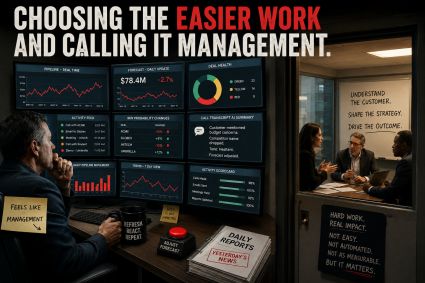
Every day, I see new tools being announced. These tools, apparently, turn things upside down. We can see reports that were previously unimaginable. Examples of new reports and dashboards fill my inbox or social media feeds. AI is giving us the capability to keep our pipelines and forecasts updated with the latest changes in real time, giving us far more insight into performance. We now have the ability to have the most current pipeline and forecast on demand.
And managers seem to be jumping all over this capability. They are captivated by the thought that of daily or even hourly updates topipeline and forecasts. The feeling is investing this time is critical to keeping up with the pulse of the business.
As I see these claims and the associated excitement, I keep asking myself the question, “Why? Why do we have the urge to keep up to date every day on the pipeline or forecast?”
In most complex B2B environments, the pipeline and forecast won’t change that quickly, and if it does, it should be cause for huge concern. As an example, though it was years ago, I was working with the B2B products group of a very large Japanese company. As we went into September, the corporate leadership in Japan insisted on daily pipeline and forecast reviews. In some way this was understandable. The largest part of the business focused on consumer products, TVs, stereos, refrigerators, washer/dryers. The last quarter of the year drove about 75% of their sales. So the daily forecasts made sense.
But in this business unit, sales cycles were 15-20 months. The pipeline and forecast didn’t change significantly on a weekly basis. Yet the organization was being forced to provide updated reporting every morning. I kept suggesting, “Just send a copy of yesterday’s report…..” As much as the team wanted to do this, it wasn’t acceptable. The CEO of the division and I ended up going to Japan to explain to the executive team how the business was different and how much time was wasted by preparing daily reports that offered no new insight. We suggested an update every 2 weeks, ended up compromising at weekly. It still was much too frequent but it kept the corporate management off the backs of the leaders of this business unit.
Now, we seem to find ourselves in the same place my client was so many years ago. Managers are excited about the ability to spend time, every day, with the latest updates and changes to the pipeline and forecast.
The problem is the same as it was years ago with my client. Reviewing the forecast or pipeline every day won’t show big changes in complex B2B. While there may be small changes based on a call a salesperson makes today, the aggregate impact of these small changes is minimal. Some think the daily updates provide greater accuracy, but reviewing it daily doesn’t improve the accuracy. The accuracy comes from the quality of the data and the underlying assessments. It comes from understanding the reality of what the customer is doing, not the number of times we inspect the data.
Deals slip on their own timelines, the customer’s, not ours. And if we aren’t sitting in the room observing what the customer is actually considering, we won’t be more accurate. And even if we are, the customer is constantly re-evaluating and shifting, so past history and analysis isn’t that helpful.
Yet because we have tools that can amass a huge amount of data, make sense of signals and provide us real time updates to everything that is happening; managers are investing time in studying these daily.
The issue then becomes, how are we using these daily updates, what are we doing to adjust our strategies? And if we are making these daily shifts, are we actually improving things or creating more confusion?
In most cases, what we are getting isn’t greater accuracy, they are offering greater currency.
In fact, more frequent review may degrade accuracy rather than improving it. Assessments change after every interaction. A customer may have gotten up on the wrong side of the bed, a meeting didn’t go that well, we see this in the call transcripts and the forecast is adjusted down. The next day, calls on the customer went very well and the customer was enthusiastic about the potential solution. The forecast increases. And at the same time the customer may have been enthusiastic about all the alternatives.
We can see daily fluctuations in the forecast and pipeline. And soon, neither becomes a representation of the reality of the deals, but they are reflections of our reactions to what is happening. We end up responding to the daily fluctuations rather than looking at the longer-term trend of the progress the customer is actually making. And when we are adjusting pipelines and forecasts based on these daily reactions, these adjustments pile onto previous adjustments, tending to drive more inaccuracy over time.
And this error gets replicated across everything we do. Because we have collapsed the cost of creating this data to zero, we can now spend time looking at and reacting to everything we see. We get to review every call report and transcript, every meeting report, every conversation, we see every activity our sales people are doing, tracking them on an hourly basis. I’m anticipating that soon, managers will correlate the number of cups of coffee along with the subsequent bathroom breaks to my quota performance.
Just because the tools enable us to monitor progress on an hourly basis, the question is, “Does that help us better understand what’s happening, does that help us in coaching seller performance?” Or are we spending a lot of time reviewing our dashboards, just because we can?
Somehow, we think monitoring these things, constantly, is progress. Refreshing the pipeline feels like managing the pipeline. Listening to every call feels like we are developing our people. Scanning the dashboard feels like running the business.
All of this has the feeling that we are paying attention and are actively engaged. But it is also an avoidance trap. We choose this work because the tools make it easy, and because choosing it lets us avoid the work that actually matters.
That real work is harder and slower. It takes time, patience, and insight to sit down with your people. Walking through a deal strategy is more than reading a dashboard or a transcript summary. Understanding the pipeline involves understanding how the seller is thinking about the pipeline quality and their plans to hit their pipeline goals. The forecast requires understanding where the customer is in their thinking, the importance of the project at this moment in time. And this is the work through which managers actually develop the insight, knowledge, and judgment that make them valuable. None of that capability is built by watching a dashboard. It is built by doing the harder work the dashboard is letting us skip.
In the end, what we can point to on a report or dashboard is the starting point. It doesn’t provide insight into what’s driving the activities and performance.
But now, rather than investing our time in understanding our people, the key drivers to the business, and how work gets done, we are spending our time on these constantly refreshed reports and dashboards provided by the tool.
The watching crowds out the real work. We were handed our time back by these tools, and rather than spend it on the work, we poured it straight back into watching the work get done. The tool becomes the excuse not to do the thing it was supposed to free us to do.
The fix starts with recognizing what is actually most important and impactful now. It was never information. We are drowning in information, and the tools have made it abundant and nearly free.
What is scarce is attention, knowledge, experience, and judgment, and those have not become cheaper at all. They are the same finite resource they have always been. Which means the discipline is no longer gathering and reviewing. It is deciding what deserves our attention in the first place.
That changes how you work in three concrete ways.
• The first is that you start from the decision, not the data. Before you open the forecast, ask what you are actually trying to decide and what you would have to see to act differently. If you are deciding where to put your own time this week, the deals that haven’t moved and aren’t going to move don’t need your attention, however easy the tool makes it to look at them. You review the pipeline to make a decision, not to confirm the number.
• The second is that you attend by exception rather than by sweep. The tools make a comprehensive pass possible. Every call, every account, every rep, all reviewed uniformly and consolidated into these summary pipeline and forecast reviews. But the aggregation loses the detail, and it is in the details that managers have the greatest impact.
The manager’s judgment is valuable when it changes an outcome. This means it is most impactful when looking at the deal that is winnable but at risk, or on the rep who is struggling and coachable. Instead the time is being spent, daily, looking at aggregated data that doesn’t identify the specific areas the manager can impact.
Looking at every deal, listening to every call, looking at every note or summary, spending time on everything these dashboards can show you, isn’t where you have the impact. Listening to the one or two calls that tell you something about the seller and how you can have maximum impact on how they work, that is where it matters.
Looking at the winnable deals that are stalled, helping to understand why, and figuring out how to get them moving is where managers have the greatest impact. Managers eliminate this impact, abandoning the place where they matter most, when they are spread thin looking at everything the dashboards can show.
• The third is that the time you free up has to focus on the work the tools cannot touch. The tool can keep the pipeline current. It cannot have the conversation with the customer that tells you whether the deal is real. It can transcribe and summarize every call. It cannot develop a rep into someone who makes good calls without supervision.
It can flag a deal as at risk. It cannot make the judgment about whether to walk away or fight for it. That work does not scale, does not refresh on a schedule, and never shows up as a clean number on a screen. Which is exactly why it is the work that belongs to us, and exactly the work the watching is so good at crowding out.
The tools gave us our time back. That is the genuine gift, and it is worth taking seriously. The only question that matters now is whether we have the discipline to spend that time on the work, or whether we will spend it watching the work happen.
If we choose to invest our time in watching the work happen, we are choosing to skip is the work through which we develop the insight, knowledge, and judgment that make us worth having in the role at all.
Skip it long enough, and there is nothing left of us that the tool couldn’t have done on its own.
Afterword: These AI generated discussions provide such fascinating perspectives on this post. Enjoy it!

