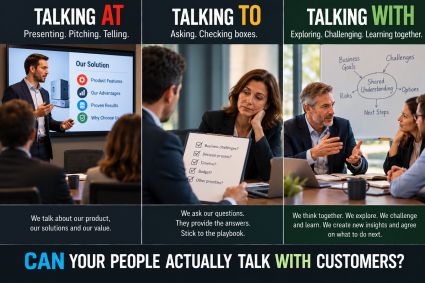
Reading the title, many of you may be scratching your heads, thinking, “Dave, of course they talk to customers. We measure it every day. What’s the deal?”
There are two critical words in this title. The first is “Can,” the second is “With.” Let me start with “with” before I address can.
I know it’s a wording difference, but it’s the difference that completely changes the conversation. I’m suggesting we talk “with” customers, rather than talking “at” or “to” customers. It’s a huge and important difference.
Traditionally, we’ve focused on presenting and pitching. Our discovery calls look like interrogations, as sellers walk through their checklists. In the first, we are talking at them. In the second we are talking to them.
We have our playbooks and discovery decks. We check through the questions in them, getting the answers. The customers are answering our questions. They are used to the ask/answer game that doesn’t reveal a whole lot.
But are we connecting with them, particularly with the things they really care about? Are we engaging them in collaborative conversations where all parties learn and grow?
Are we working together to set the agenda? Is the customer asking us questions, not just about the product, but are they seeking insight into what might change, why it’s important? Are we helping them understand and manage the risk?
Did we and the customer leave the conversation knowing something each of us didn’t know before? Did we and the customer change our views based on what we have each learned? Have we agreed on the next most important steps?
Are we developing trust through these conversations?
Most of you won’t be surprised. We’ve known this. We struggle to practice moving from the “to” to “with.”
But here’s where that struggle rests. “Can” our people engage in these conversations?
While our people know about collaborative conversations, they may not be able to have them. They may not have a deep understanding of the customer, their business, their challenges and what they mean. It may be as simple as they can’t even speak the language of the customer. The language used in healthcare differs from financial and professional services, industrial products, SaaS, and others.
It may be they don’t understand the problems the customers are trying to address. Just because we understand what problems our products solve, it doesn’t mean we understand the problems. We don’t understand how they arise, how to define them, who they impact and who needs to be involved. We don’t understand the changing risks as the customer seeks to understand, define and take action.
When we don’t understand our customers or the problems they are trying to solve, the only safe positioning we have is talking at them, delivering our pitches. Or talking to them, using our scripts and playbooks.
The pitches, scripts, playbooks, products are the things we know, so we tend to stick with those things. In too many organizations, they are the things our leaders compel us to do.
But they stand in the way of understanding and, consequently, helping our customers.
We leave customers on their own to figure all the tough stuff out, which is why we see so many “No Decisions Made.”
What does it mean to understand our customers? What does it mean to understand their problems? Let me take these separately.
Customer acumen means understanding customers and their roles. It includes understanding what they are responsible for, who they are responsible to, who do they depend on, how they get things done.
None of this has anything to do with what we sell. It focuses on their work, what it means to them and how they achieve their goals.
Problem acumen takes this a level deeper, focusing on the customers’ problems and opportunities. How do problems emerge? How do they recognize them? What’s the impact on the organization? What happens if they do nothing? What risks arise; how do they understand and manage them?
But there’s a catch to this. We can’t walk into an opportunity, call a time-out, saying we need to learn this stuff first. This slows the customer down. We have to understand these things before we walk into the meeting.
Acumen enables us to know enough about customers and their problems to think with them, not just ask them about it.
It’s this customer and problem acumen that makes the most impactful conversations possible. Sellers don’t need to follow their checklists or even the questions AI recommends, because they know what matters.
Their questions demonstrate this understanding to the customer. We start creating value from the very first interaction.
In doing this, we can now talk with the customers about what matters most to them. It enables sellers to engage without ever mentioning the product.
Acumen, itself, is general. It focuses on certain industries, functions and roles.
It gives the seller a general understanding about how organizations work, how problems arise, how people get things done, and what they tend to care about.
As we look at a specific customer organization, or buyer in the organization, we leverage our acumen to research and understand what they may be facing. We develop premises we can begin to explore in those first conversations.
And this is where it gets interesting. Sometimes our premises are wrong. But they earn credibility because the customer recognizes the thinking and understanding required to develop the premise. The premise is where collaborative conversations start.
Some will say, “AI can give us all that! Plus it can make it specific to the customer we are trying to meet.” Of course, AI might give you the starting point. But then the customer responds, “Tell me more.” “That’s not an issue for us.” “We look at things differently…” While we may be able to ask the first question, without acumen, we can’t engage in a conversation.
Acumen isn’t just information we learn. It’s knowledge applied with judgment. It’s the ability to recognize patterns, knowing how to identify symptoms, knowing what the customer might be missing, or offering customers a different point of view.
Acumen is a skill critical to all sellers. It can be developed. It can be coached. It improves with every meeting.
Organizations measure calls sellers make. They measure meetings, talk time, script/playbook compliance. Management and enablement compel their people to do these things.
They don’t test whether the seller can have a 30-minute conversation with a customer without talking about their product.
For leaders, it comes down to one question.
CAN your people talk WITH your customers?
Afterword: A commercial advertisement. We have been working people in customer and problem acumen for over 25 years. Thousands of sellers are using what they’ve learned to engage their customers more deeply.
If you want your team to learn how to talk with your customers, contact me. The programs include a number of AI tools to accelerate learning. Reach out at dabrock@excellenc.com
Afterword: A great AI based discussion. One of their examples, using these talking at/to our dates, was a hilarious, but very appropriate example. But toward the end, they raise an important question, “If the script is gone, who are you?” Enjoy!

