I was fascinated to read a recent WSJ article: Bosses Want the Secrets of the Family Firm That Never Had a Layoff in 75 Years. The Gund Company has grown an average of 18% a year for the past 10 years. And it’s done without any layoffs.
It is a fascinating contrast to everything we read about business and leadership today. It’s all about AI. Too many discussions focus on how these tools dramatically improve efficiency, suggesting people are much less important in the future.
We read of the human in the middle; that’s code for there will be humans left. But we seldom talk about why they are there and what they do. “They do the thing AI can’t do,” but we don’t go much deeper.
And we rarely talk about what leadership becomes in this new world.
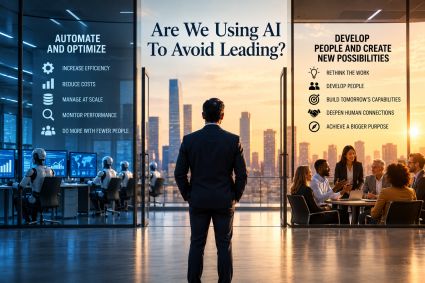
The current state of discussion leads me to ask the question, “Are we using AI to avoid leading?”
Let me be clear. AI is not creating this challenge. It’s exposing leadership shortcomings that have existed for decades.
We’ve confused management with leadership. We focus on activities, processes, compliance, measurement and control. We manage to the numbers and people are just resources to be deployed efficiently. They are indistinguishable from how we look at investing in tools, software and other things.
They focus on output and hitting the numbers. Managers sit at their dashboards, twisting the dials. But we seldom hear managers talking about developing their people, building trust, expanding their capabilities.
And we have seen year over year declines in employee engagement and trust.
If our priority as leaders and managers is monitoring and controlling the work, AI makes us tremendously effective in doing this.
As I’ve mentioned in so many other articles, AI only amplifies our capabilities. From a leadership perspective, it doesn’t fix a flawed leadership philosophy, it makes it more visible.
Have we forgotten what leadership is about?
Is it merely about producing results, keeping investors happy, and maxxing their own bonuses?
This is what makes Gund interesting. While they have succeeded in growing, they look at leadership differently. Several principles stand out (Note, Gund has its 12 steps. I’ve consolidated several and am focused on those most critical to the issue around using AI to avoid leadership.)
- Purpose: The organization exists to create value beyond short term financial measures.
- Caring: People, customers and business performance are tightly interconnected. High performance is part of caring. Gund phrases it in this way: “Taking care of each other, taking care of the customer, taking care of the business.”
- Engagement: Leaders go to where the work happens. They listen and understand. They develop the capabilities of people to identify, understand, and solve problems.
- Trust and accountability: Transparency, empowerment, responsibility are fundamental to how the organization operates.
- Leadership owns these: They set the personal example; they seek people who are aligned with these values.
As we look toward leveraging AI, the focus of too many has been efficiency and productivity oriented. But the question is, “how are we using AI to strengthen our people, develop their judgment, expand their potential, and create new opportunities?”
How do we use AI to avoid leading?
We avoid rethinking the work. AI gives us the possibility to do the current work much more efficiently. Doing the work faster doesn’t mean we are doing the right work or doing it better. Rethinking the work is different from automating the work. Too often, we use AI to continue doing what we have always done, rather than rethinking it.
We use AI to optimize today’s performance, avoiding thinking about the future. This quarterly focus takes our eyes off managing for the future. We focus on tactical activities, at which AI is superior, but forget to understand what this means for the future. Will we have the capability to achieve our goals in three, five, or ten years?
We invest in technology, avoiding developing the capabilities of our people. But the process of engaging our people is messy, tough, and takes time. Since we are so focused on today’s performance and technology has been our performance remedy for the past 15+years, we have forgotten about developing the capabilities of our people.
As we look to the future, we don’t have the necessary skills to move us there. This isn’t just at the individual contributor level, but as leaders we haven’t invested in developing ourselves.
AI can help us in a lot of these areas, but it cannot take responsibility for doing this.
The more we surrender our business and leadership strategies to AI, the more we surrender achieving what we are in business to achieve.
As I reflect back to The Gund Company, they have chosen to do the hard work. They set high standards and have high expectations for everyone in the organization. People who don’t fit leave. But the people that stay are aligned with the goals of the organization and with their responsibilities within that organization. And they care for each other, their customers, and the business.
And this is maintained through strong leadership.
At its core, this issue is not about AI. AI can help us do a lot of things.
But it can’t tell us what matters.
It can’t establish our purpose.
It can’t make the commitments necessary to achieve that purpose.
It isn’t accountable for the consequences of our choices.
We are using AI to optimize today’s performance without developing the capabilities for tomorrow.
What does leadership mean in an AI world?
Is AI part of your strategy to extend the capabilities of your people and the organization, or is it a cost strategy?
If the focus on AI efficiency only results in layoffs, whose failure is that?
Is AI enabling your people, customers and your business performance to become more tightly interconnected? Do they understand each other and work more impactfully together? Or is AI substituting for those relationships?
Are you now spending more time where the work is getting done and with your customers? Or are you managing the dashboard?
Is AI making you more transparent with your people, or is it just giving you more visibility into what they are doing?
Is AI making it easier for you to substitute leadership responsibilities with management activities?
Leadership is about imagining new possibilities and aligning the organization in achieving them. AI can free up time to focus on this. Are you leveraging it for these purposes, or are you using it to do more of what you’ve always done?
Are you using AI to avoid leading?
Afterword: You are probably getting tired of how I rave about the AI based discussions of this post. This is another fascinating one. And some of you may be thinking, “Dave you should be leading with this, not the article.” But I assume you already are scrolling to this, so I won’t change. In any case, this is great!

