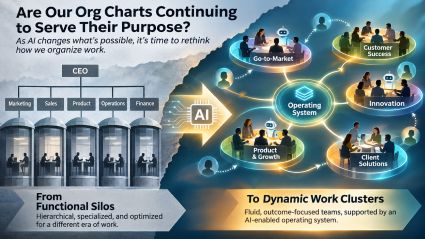
Dave Jackson and I just had a fascinating conversation about modern organizational design. We are circling around different ideas of what modern organizational design looks like.
Part of what we are seeing is not new news. The traditional functionally oriented organizational design has been plagued with the “Silo” problem. While each function may be working very well within those functions, as work gets passed from one function to another various challenges arise.
As we implement AI, we are seeing new challenges/possibilities. As work gets eliminated at various levels, what should the new organization look like. Where does an agent sit in the org chart? Are orgs going to flatten? Are they going to shed massive headcounts? Will classic organizations even exist?
How does AI force us to rethink our organizational designs?
I got intrigued considering the idea of what modern organizational design looks like. As a result, I will be writing about 6-8 posts looking at modern organizations from different perspectives.
Before I go any further, let me say there is no right answer. For decades, we’ve seen varieties of organizational designs. In the future, we will see more varieties, each working in a different space. Underlying this is the idea that “not all work is the same.”
But what we must start thinking about is “does the organizational design fit the work?” Today, we tend to design the work to fit the function/organization, rather than the inverse.
But let me go back to look at how we got to where we are right now.
The functionally structured organization was a rationally designed to solve the problems of the time.
Going back to the 1800s, military models with formal line and staff structures, chain of command and spans of control. This was required to effectively manage large numbers of soldiers across a wide space, required clear lines of communication and authority.
In the mid 1800’s the railroads had to coordinate the work of thousands of people spread over great distances. Errors committed by people in the organization could kill people. The first of what we look at as traditional org charts was developed in 1854-55 for the New York and Erie railroad. It created formal lines of authority and reporting.
These were, for their times, examples of designing the organization to fit the work. That work was running a railroad over very long distances, minimizing the opportunity for error in which people might be killed.
In the early 1900’s people like Weber, Taylor, and Fayol started looking different management models. In these, specialization by function was a fundamental design premise.
Mass production drove specialization and standardization at scale,
Divisional, business unit, and brand management structures were developed at places like Dupont and P&G to help manage very diverse product lines at scale. Chandler posited “structure follows strategy,’ in his Strategy and Structure (1962)
Through this evolution of organization design, we saw a consistent approach where the organizational design or structure fit the work.
Some of the constraints driving this structuring:
· Information was expensive and slow.
· Much of the work could be standardized and more predictable.
· Specialization and standardization enabled strong scaling.
· Decision-making and judgment concentrated at the top of organizations.
· Accountability and control needed clearly defined structures.
In the 1950s-60s, we started to see shifts in how organizations worked. As markets started becoming buyers’ markets, much of the work shifted to understanding customers. But the structure for producing products stayed the same. Ted Levitt’s Marketing Myopia (1960) illustrated that Railroads viewed themselves in the railroad business, not the transportation business. It became a classic example of defining work by function.
In the 1960s-80s, “Management by numbers” became the dominant strategy. Strong financial controls, creating shareholder value drove the design of work to support the function.
Then in the 1990s and onward, software started locking this in with ERP, CRM, Financial Systems encoding functional structures and metrics into the design of the work.
In the mid-2000s we started seeing more formalization of this through embedding functional workflows into our IT support systems. ERP, CRM, Financial and HR products each reinforced the silos they were originally designed to fit. These critical enterprise software systems hardened the functional silos because information could not flow easily from system to system.
Where originally, the functional based organizational design focused on supporting the work that needed to be done, over decades, the focus shifted. Work was designed to support the functions doing the work, these functional silos became hardened with management by numbers and the underlying software structure.
Today, we are seeing too many organizations struggling with strongly function oriented workflows. We see each function or box on the org chart optimizing to achieve their own goals, increasingly creating conflicts with the rest of the organization.
In GTM we see continued finger pointing, “Marketing isn’t producing MQL/SQLs, SDRs aren’t scheduling enough meetings, AEs are ignoring all of this and doing their own things, RevOps and Enablement provide reporting, tools, and training that no one uses.
Further hardening occurs as metrics, budgets, and careers became defined by the boxes and functions.
We are finding the structures and processes have become more important than the outcomes they were originally intended to produce.
At the same time, we see saw attempts to work around these functional boundaries. We’ve seen some organizations create clusters for work. Probably some of the most famous are Haier, Zappos, Toyota’s manufacturing cells. We see professional services teams organizing around the client projects. We see companies like Apple create innovation teams. And we see companies trying “matrix management.”
These have produced mixed results. Haier, Toyota, Apple, have created variants or the traditional organizational structure, yet enabling work groups focused on the work that needs to be done. Others, like Zappos were interesting experiments, but not necessarily sustained successes.
And while some orgs continue to promote their org charts showing matrix management, when one traces metrics, performance, reward/promotions, and careers; we tend to see the functional organizational structures dominating.
But what all these have done, regardless of their success, is they sought to recognize the importance of designing the organization to support the work.
Different types or work require different types of organizations to support it. Highly predictable, repeatable work, such as manufacturing or accounting might best be supported with standardized processes, automation, and clearly defined responsibilities.
Work where we face uncertainty, ambiguity, disruption, and change may require different approaches.
I will be exploring these in future articles. But I wanted to bring the discussion back to AI.
So much of the discussion of AI focuses on how it impacts our traditional organizational structures. Organizations can be flattened because entry level jobs are better performed by AI. Management layers can be reduced.
Much of the discussion focuses on how we can eliminate the boxes, and most of this is looking within the functional silos, themselves.
We are applying AI to work that has been designed to reinforce the organizations, rather than the work that needs to be done.
But is this the best way to leverage the capabilities of AI? What if AI is removing some of the constraints that made the structures important in the first place?
What if we looked at the work that needs to be done?
How do we leverage AI to support that work? What are the organizational structures needed to best leverage AI in performing that work?
I started this article with the idea that we originally started designing organizations that supported the work that needed to be done. Over time, we inverted this, designing work to support the organizations we created.
AI is forcing us to look at the problem in ways we haven’t looked at it before. But are we asking ourselves the right questions?
Rather than continuing to optimize our current siloed orgs, we can rethink our organizational designs
In the next article, I will be looking at, “What is the work?” Specifically, I will look at inside- out versus outside-in designs.
Afterword: I love this AI based discussion of the article. They are able to dive more deeply into many of the historical examples I look at, providing better explanations. There are a few places, where I think they are jumping the gun in declaring the “modern organization dead,” but these aren’t distracting. Enjoy!

