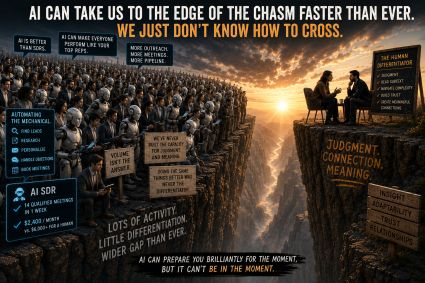
AI is better than your SDRs. That’s true. And it’s beside the point.
A writer I follow published a piece this week that I’ve now read three times. Not because it’s wrong, because it’s honest, and because it stops one sentence short of what really matters.
He describes watching an AI agent book fourteen qualified meetings in a single week. It found the leads, researched them, wrote the personalized emails, handled the objections, and scheduled the calls. No human touched the process. The cost was $2,400 a month against roughly $6,000 for a human doing the same work, plus weeks of onboarding.
And then he writes the line he says kept him up at night: “The AI was better at it than 80% of sales reps.” Not pretty good, but better and more consistent.
I believe him. I’ve seen the same thing. Deploy these tools. Use more of them, not fewer. Nothing I’m about to say is an argument against AI. We should be moving faster on it, not slower.
But he calls out something else in his article. And I see the same thing in the 100s of “AI is better than” articles.
The tell
These articles easily prove that AI is better than your average rep. Ho-humm, tell me something new.
Increasingly they reach higher, “AI can make everyone perform like your top reps.”
But when they start explaining, they never quite get to what makes the top performer different. They end up reverting to the things everyone does, top reps just do those things better.
Close, but no cigar. Doing the same things better was not what set those top reps apart.
The author of the article, to his credit, starts to look at this issue. He says, AI SDRs are incredible at top-of-funnel work and terrible at everything after someone replies with interest. His words: “They can’t read subtext. They can’t navigate complex objections. They can’t build genuine trust.”
And here’s the real challenge. Everyone is running to the edge of a chasm, and stops.
The thing that separates top performers from everyone else was never volume. The very best SDRs and AEs are not the ones that sent the most emails or made the most dials.
They are the best because of judgment. Their ability to read the situation and adapt to it. Seeing what no one else was seeing, understanding what the customer means, not what they said. To connect with the customer in ways that build confidence and trust.
It’s important that we understand the “AI is better than argument.” It can drivehuge improvements in efficiency and, with them, cost reduction.
AI has commoditized the mechanical parts of any job. Emails, research, call prep, analysis, reporting. The bottom 80% of our organizations were doing this work poorly. Without a doubt, AI does this work better, more consistently, and far more efficiently.
But this doesn’t solve the problem. It aggravates the problem.
The real work that made top performers different was the judgment and ability to connect with customers in meaningful ways.
With AI, we now have better outreach, more qualified leads, more meetings. But we don’t have the capacity to do something with them. We’ve never built the capacity to engage customers with judgment and meaning.
We are creating a wider gap than has ever existed in the past. And we aren’t asking the question that matters: “How do humans get better at the things that AI can’t do?”
AI can prepare you brilliantly for the moment, but it can’t be in the moment.
AI can take us to the edge of the chasm faster and more efficiently than anything before. We just don’t know how to cross.
How the job got this way
Here’s the question almost nobody asks it: “why does modern selling need such staggering volume in the first place?”
It didn’t always. When knowledge and judgment were central to the job, you didn’t need hundreds of touches to create interest. A handful of well-researched, insight-led conversations did the work. The volume is new.
And the volume is not a feature of good selling. It’s what remained when we took the most important things away.
Somewhere along the way we designed the judgment out of the role. We misapplied lean and agile principles. We took what used to be knowledge work, breaking it into pieces so we could hire cheap and interchangeable.
We took that piecework, measuring it by activity; emails sent, dials made, sequences completed. Leaders gravitated to this because activity is easy to count and judgment is hard to see. Particularly if these leaders didn’t, themselves, have the time to build the judgment.
Once the job is defined as “generate high volumes of scripted touches,” we’ve defined the machine. We filled those roles with people until the machines showed up.
And AI is just the latest machine in a long line of tech stack machinery we built for the job.
This reframes the article that incited this post. “AI is better than SDRs at volume.”
It’s better because we hollowed out the roles, so the only answer was automation.
Let me stay with this a moment. AI isn’t what created this. It’s what illuminated it. We have year after year of falling results, year after year of increasing automation. Year after year of removing the human differentiator in selling. AI has just shown a bright light on it.
But this has created a trap that too many organizations don’t understand. Leveraging AI for roles that haven’t meant anything doesn’t solve the problem.
So here we are. AI does the SDR (and other) jobs better than their human counterparts. But what we are measuring is the part of the job that was lease important and what humans shouldn’t have been doing anyway.
We are still missing the answer to the question, “How do humans get better at the things that AI can’t do?’
What AI Masks, And Then Makes Worse
In the previous section, I recognized the volume argument. AI does the mundane work better than humans, the research, the outreach, the follow-ups. The discussions which have consumed too many for years, the volume/velocity discussions have been made redundant with AI
Where does it leave us?
Many revel in this. Where before it may have taken 100’s of outreaches to generate a single warm reply, today, each rep arrives at their desks with 10 warm replies AI has developed.
You can see the underlying cost argument as well. “If we were paying 10 reps to manage one warm reply a day, now we only need one to deal with the 10 sitting on her desk.
The author talks about his experience. In a section called “The Part That Bothers Me,” he writes about his own start in sales: “A hundred cold calls a day, a lot of rejection, learning through repetition.”
The issue was never supposed to be about the number of emails, dials, or outreaches a day. Those were the cost of creating a single warm conversation.
AI strips the grind away, giving the seller her 10 warm leads each morning. And it’s in those conversations the seller builds the experience and learning the author cites.
That’s the promise, AI clears the grind, freeing sellers to spend their time in conversations with prospects and learning from them. If that were true, I’d be all in!
It isn’t. And the reasons are the real problem.
Start with those ten leads. To put ten warm conversations on a rep’s calendar every day, something ran hundreds of thousands of outreaches to find them.
The rep sees ten. She never sees or cares about the thousands of outreaches needed to give her 10 warm leads a day.
We haven’t escaped the volume/velocity model. AI has enabled us to amplify it at far less cost. We aren’t doing less volume; we are doing more than any human organization ever could.
And this isn’t new or just attributable to AI. For years we have been automating more of the rep’s job in the pursuit of volume. AI has changed the economics of this.
But at the other end of each of those AI outreaches is a prospect. They have become the punching bag for, not only our outreaches, but for all our competitors and hundreds of other organizations that have that individual on a list.
When we get those 10 warm leads, so much of the prospect’s patience and goodwill has been exhausted. Each conversation starts in a deep hole we must first climb out of.
Response rates continue to fall, but we miss this because AI can easily up the volume to provide each seller their 10 warm leads.
We see customers seeking alternatives to learn about new solutions. But AI has, for the time being masked, all that from us. Again, with hundreds of thousands of outreaches, we arrive at our desks each morning with 10 fresh warm leads.
We haven’t yet talked about the AI tools that customers are deploying to protect them and to find what they really need. But that’s not the focus of this post.
But now we’ve created another problem. We removed the scarcity that made each conversation matter. Those hard fought and won outreaches that resulted in the one conversation. It was unthinkable to squander that opportunity.
In the old days, we would research and prepare. Doing everything to take advantage of that one opportunity.
Then volume took over. As the focus, over the last 10 years has been on generating more leads, the time to prep for a call, the time to learn how to have a high impact conversation disappeared.
And, as we lost the time and ability to design and conduct high impact conversations, something changed. Increasingly, our “conversations,” became scripted pitches with one question at the end, “What discount do I have to give you to get an order by month end?”
The skills we were supposed to build were crowded out in our busyness and focus on volume and velocity. Where managers used to coach us, new generations of managers also lacked that experience base and could coach on nothing but, “hit your activity metrics, follow the script.”
And today, AI strips out even more of this work. We don’t have to do the outreach. It provides our 10 warm leads in the morning. And now, we don’t have to do the research or call planning. AI has done that for us. We just have to be able to have the high impact conversation.
And that’s where the rubber meets the road. Great opportunities are created in the initial conversations. Trust, confidence is built one conversation at a time. Deals are won when we and the customer arrive at the endpoint together.
But do we have that experience? How many of these conversations do we actually have? Have we had our teeth kicked in enough to learn how to adapt and change to fit the circumstances.
This is the precipice I keep talking about. AI has eliminated every barrier to getting to this point, but we are stuck. We are standing at the edge of the precipice unable to take the next step.
Why we can’t see it
So why does nearly everyone stop at the edge? Here’s what I am seeing, and it’s less cynical what you might expect.
Let me lay some groundwork. Most of the leaders and sellers I encounter are smart people. In technology, with all the pressure on scaling, one might think it’s greed or shortermism. It happens, but in my experience it’s rare.
At the core, it’s a whole generation of sales leaders, especially in tech, are products of the process. They started as SDRs inside a faulty selling theory. They learned how to run their sequences, hit the activity numbers, manage the volume.
The entirety of their careers was invested in mastering that single model. They progressed from SDR, AE, front line managers to CRO.
They were never challenged to recognize judgment as a distinct, buildable capability. They were part of not just a company, but an entire ecosystem that had engineered this out. Enablement focused on products, pitches, the process, and tools. The tools facilitated increasing levels of automation. The metrics were dominated by volume/velocity. And the customer was almost forgotten, being relegated to being the target of all these initiatives.
As a result, we have a generation of sellers and leaders that never knew they were missing something. When they missed goals, or the results were poor, the only means they had was to do more. And the more they failed, the only escape was to blame the tools, the process, the training, the programs. That was all they could see.
You can’t miss something you can’t see. And today we see so many organizations reaching the precipice of the chasm. They are doing the only things they ever knew how to do. They are doing the things they see everyone else doing.
But something is missing. They reach the edge of the precipice. They can feel something isn’t quite right, but they don’t know how to call it out.
They examine and benchmark the top performers, what they see is these top performers doing the same things everyone else is doing, only better.
But in that examination, they are missing what really sets top performers apart. The ability to engage the customer in a meaningful way. An ability to adapt what they do to the moment. The willingness to abandon what they’ve always done but isn’t working for this situation.
That’s what most leaders are blind to. They’ve been trained to focus on volume/velocity, so they focus on how top performers do that better and differently.
So how did we get here?
It is sellers, leaders, enablement, ops, marketing building the models they were, themselves trained on. And in their exploitation of AI, they are focusing AI performing these same models, but better, faster, cheaper.
If you’ve never seen something before, you can’t be expected to recognize and change it.
You cannot miss what you never had. That’s why the article writers reach the edge and turn back. They can feel the gap — it keeps them up at night, they’ll tell you honestly it bothers them — but they have no category to hold it in, so it slides off, and they default to the only frame they own: cost and output. The problem is invisible to precisely the people who would have to fix it.
The chasm compounds
The reason this is urgent is this gap doesn’t stay still. It compounds. Less judgment means we need more volume to compensate. That’s been the modus operandi for close to 10 years.
More volume drives more automation, which develops less judgment. And AI is the gas that we pour on the volume/velocity fire.
With all the excitement. With all the “experts” showing how to add their version of the gasoline to the fire, the single most important thing. The thing that has always been the most important remains unaddressed.
There is another compounding factor. Judgment, experience, and the ability to engage the customer in meaningful conversations is a lagging indicator.
We run the risk of recognizing this long after we’ve lost it.
Month to month, quarter to quarter, our solution is to focus on volume/velocity. Those few sellers that can bring judgment and experience into each conversation are ignored. They go some place else.
Because we don’t know that we should be looking for this, we never notice until it’s gone.
And the path to recovery isn’t easy. Recognition of the importance is the first step, but then trying to build or rebuild it into the organization can take years.
This is not a new story. We’ve been living it for years. In tech, we see 100s of organizations quietly failing. Today, some can give the excuse that AI caused this, but AI just accelerates it.
Crossing it
I’ve painted a pretty bleak picture. But I’m optimistic. I see several paths forward.
Here we are standing at the edge of the precipice. We have the discomforting feeling that we may be missing something. Instinctually, we know there must be a way across.
First is to go back to the basics. Some fundamental questions we stopped asking.
First, what is the seller’s job? Ultimately, it is to connect with the right customers in meaningful ways, to help them change. Almost everything surrounding that is grunt work that AI does better than humans.
Assess, do my people have the skills to do this. If you are being honest with yourself, you might ask whether you have the skills to do this. As you identify them, and begin to work developing them, recognize this isn’t a training problem. It’s an experience problem. How do people gain this experience? Where do they get the chance to start developing their skills? Where is their apprenticeship?
Where do they get the opportunity to get their teeth kicked in, and the coaching to learn from this?
Second, this is an investment, in your people, your leaders, your organization. How do you fund this investment?
AI takes the cost out of the “mechanical layer” of what we’ve been paying our people to do. Take that money and re-invest it. Use that money to hire people who have the judgment and experience. Use that money to define roles in which people can develop this. What new apprenticeships do you need to build?
We are already seeing stories of organizations who have been hit in the face with this. One month they make news about the 100s or 1000s of people they are laying off. A month later we see them rehiring. They recognized what they lost, after they lost it.
Third, while I’ve focused this discussion on sellers and leaders, the same thing is impacting every role in your organization. Think of why does each job exist. Ironically, I leverage my learnings from lean and agile to help with this. Each job has a customer. Each job must support that customer in doing their job.
Doing this exercise in the new sales context means redefining each job. If the job of the seller is to connect with customers in meaningful ways to help them change. Then enablement’s job changes. It’s less focused on products, technology, or even methodology. They have to say, “How can we help our sellers have high impact collaborative conversations with our customers?”
Each role changes in parallel ways, each leadership role also changes.
Fourth, measure the right things. Measuring activity defocused sellers from high impact conversations. Think about, “How do we know if judgment is developing? How do we know if any of this means something to the customer?”
Fifth, this rebuild starts with the leadership team. I’ve alluded to this, but before even looking at steps one-four, the leaders must focus on themselves and what they are doing. Have your leaders built their own judgment and ability to adapt to the specific situation? Do your leaders demonstrate the behaviors critical to driving performance? Are they building the culture of the organization around those behaviors.
I’ll wrap this up with one final critical issue, patience. It took years for these capabilities to be eliminated in our organizations; it will take years to restore and rebuild it. If you are a senior leader, reflect back on the years of experience it took for yourself. Think of the failures, mistakes, and how you learned from them. The time each person in your organization takes will be no different.
The real question
AI is the best thing to happen to selling in a generation. It’s also a mirror.
It didn’t create the chasm, it revealed it.
It stripped away the volume/velocity we’d been hiding behind, revealing what has been missing; : real judgment, experience, the ability to adapt, in the moment to what’s important to the customer.
The articles will keep coming. The experts will keep counting the hours they saved. The vendors will keep selling you how they can do the work for the sellers (and perhaps yours, as well).
People will focus on top performers, citing all the work they are doing for those top performers. But they never will talk about what made top performer different. It was never the volume of work.
Here’s the irony, for years, this gap was invisible to most of us. You can’t fix what you can’t see. By doing all the mechanical work better than any human, AI has made this chasm visible to everyone.
We can finally name it: Judgment, Experience, Adaptability. The ability to connect with what’s important to the customer.
AI hasn’t just enabled us to now see the chasm, it’s giving us the means to cross it. All the time and money we’ve poured into volume/velocity has been freed up. AI can do it cheaper/better. We can now invest that in rebuilding the human capability we lost.
It’s not a cause for despair, it’s an opening. AI has blown everything wide open.
We are no longer teetering at the edge of the chasm wondering how to get across.
We can now see it. We can put labels on it and study it.
Where we haven’t had the time to recognize this in the past, AI has now given us that time!
We just have to recognize the opportunity we’ve been given and seize it.
AI has removed the excuses to do nothing.
We have to cross. Are you going to be the one that starts building that bridge?
Afterword: Here is a fascinating AI driven conversation about this post. I always am amazed by their ability to express these ideas with very vivid examples. One that struck me is to compare the work that a Chef does to that of a food processor. What the Chef brings to the job is completely different. The chopping and cutting is left to the food processor, but that machine can’t create a memorable dining experience. Enjoy!

