I was at a party recently, for some reason people started talking about TV Game Shows. They started talking about Jeopardy, particularly the Alex Trebek days. I’ve never been a big game show person, to tell you how off target I was, as they were talking about Alex’s hosting, I kept thinking, “Well what about Vanna White, she was a big part of the show?”
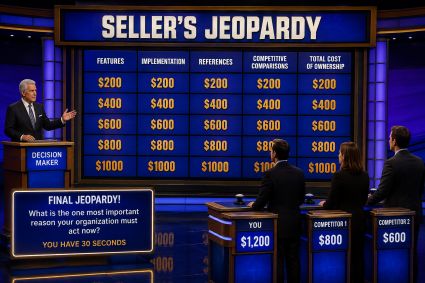
As the conversation went on, my mind went to strange places. I started imagining the game of “Seller’s Jeopardy.”
Perhaps a competition customers could conduct. Instead of answers, the board would reveal questions. Questions would be organized around themes, within each theme there would be questions having different values.
You could imagine something like, “I’ll take Features for $500,” or “Implementation for $800, References for $600, or Competitive comparisons for $1000….” You can imagine how the game might look.
The host of the game might be the decision-maker, the contestants would be you and a couple of competitors. The game would continue until the board was finished and the decisionmaker took you into final jeopardy. A tough question, 30 seconds for the best answer, for each competitor.
If you have accumulated enough in the game, whether you can answer it well, isn’t important. But if you’re behind, it’s critical, it could be the one answer that could cause you to win. They have gained some advantage with their previous answer, but this is the final determinant.
You get it, you can visualize it, standing on the stage, figuring out how to push the buzzer more quickly than the competitors, going after the highest value questions to build your credibility.
The real-world game is a little different. Rather than the person that hits the buzzer first, every seller gets to answer the same question. And, the answers aren’t really different.
What’s rewarded in the real-world version of this game is “first to answer.” First to answer defines how the customer compares and evaluates all other answers. The seller who answers first sets the ground rules for others.
At the end of the game, the bell rings, confetti falls from the ceiling, lights flash.
Alex announces, “Vanna, tell us what’s behind Door Number 3!” (You can tell I’m not good at these game shows.)
We wait in anticipation, door number 3 opens, and we see “No Decision Made!”
We had been hoping it would be a contract for us, our competitors were hoping for the same thing. But the majority of decisions are to do nothing.
Yet, we and our customers have trained each other to make the whole experience closely resemble a TV game show.
We’ve trained the customer to build the game board. They develop the categories, the questions, and scoring for each. We know we are faster at the buzzer and strive to be first to answer.
But no one is there helping them build the board.
Are they framing the problem and change initiative correctly?
Are they engaging the right people in the organization, both to help answer the questions, and to get their support?
Do they understand what they are really trying to achieve and why it’s important to them?
It’s actually not the questions or answers.
The real issue is, “How do they move their own organizations to act?”
Are your customers inviting you to those meetings?

