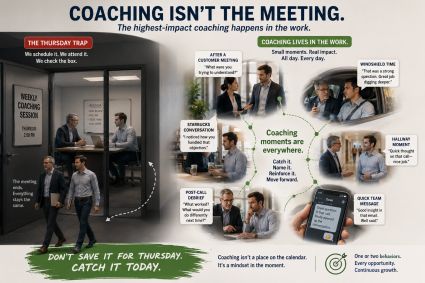
We schedule coaching. We block the calendar, our weekly meeting. Maybe an hour, maybe thirty minutes. We do the deal review on Tuesday and the coaching session on Thursday. We prepare for it, we show up to it, we get through it, and we leave believing we coached. The meeting happened, so the coaching must have happened. We check it off our list.
That belief is the problem. We’ve turned coaching into an event, a specific meeting. But the thing we are working on with the individual doesn’t work on a schedule.
Go back to what I talked about in the last post. The target of coaching isn’t the deal, it’s the behavior underneath it, the one or two behaviors that we committed to developing with the seller. But that behavior isn’t something the seller does on Thursday at two o’clock. Customer centricity shows up, or fails to, in every call they make. Discipline shows up in how they work every single day.
The behavior is continuous. It’s in everything, all the time. And you cannot develop something that should be happening all the time by restricting it to the weekly schedule.
So coaching isn’t an event. It’s a change process, and the meeting is the smallest part of it.
Here’s what this actually means. The conversation is just one point in the process. You work through the behavior in the context of real situations you have observed. You agree on what the seller will do differently. For example, we might look at the next steps in a specific deal, and when they are going to complete them.
They go work on applying these ideas. And then you come back to see what happened. That last step is the one almost everyone skips, and it’s the one that matters most. The follow-up isn’t administrative. It’s where the coaching either becomes real or meaningless. Did they try it? What happened? What got in the way? That conversation is more developmental than the original session, because now you’re coaching against their experience in applying what was discussed.
Skip the follow-up and you’ve done something worse than waste time. You’ve taught the seller that coaching is something you sit through, not something that changes anything. They learn that nothing is expected after the meeting, so nothing happens after the meeting, and the next session starts from zero. The loop never closes, so nothing changes. You’re running events forever and wondering why no one develops.
And notice where the accountability happens in that cycle. We’re quick to hold the seller accountable for applying the coaching. We hold ourselves accountable for nothing. But if you never go back to check whether your coaching changed anything, you’ve quietly decided that the having of the conversation was the point. It wasn’t! The follow-up is your accountability, not just the seller’s.
Once you see coaching as a continuous process rather than a scheduled event, the second shift becomes obvious. If the behavior shows up everywhere, the coaching can happen anywhere. It doesn’t need the weekly meeting.
And the highest-leverage coaching is usually the smallest. Windshield time after the meeting, a few minutes, a short focused discussion. “What were you trying to understand about their problem before you went into the meeting? Did you achieve that? What worked well? What would you have done differently? When are you going to try it again?”
That’s a complete piece of coaching. It’s aimed at the behavior you and the seller are focusing on, customer centricity. Having that conversation immediately after the call, while it’s still fresh in both your minds, has a huge impact. The seller can still feel what they did.
Imagine waiting to discuss it in next Thursday’s session. By then the seller has been through a dozen other calls, meetings, outreach, call prep, and proposals. On Thursday they can remember what happened in this meeting, but only by referring to their notes. The distance between when something happens and when we discuss it dulls in our memories as time passes.
Coaching moments are everywhere. After a meeting or a call, standing in line at Starbucks, passing in the hallway. None of it is scheduled. It may be a couple of minutes, one or two sentences between the two of you. But the impact of catching people in the act is profound, far greater than waiting for Thursday afternoon.
One of the best pieces of coaching advice I ever got, years ago, was this: catch a person doing something right, and let them know. We make a mistake when we aim coaching only at what people are doing wrong and what they need to fix. We have far more impact reinforcing the behaviors we want when we catch people exercising them and call their attention to it. Some of the best coaching comes from helping people understand when and what they’re doing well.
We skip coaching in the moment for one reason: it doesn’t look like coaching. We’ve been conditioned to think coaching is the meeting, that hour every Thursday afternoon. We’ve confused the symbols of coaching, the meeting, the template, the scheduled discussion, with the thing itself. The meeting is the evidence we coached. We proudly check the box, and on the next survey we claim that hour as proof we’re coaching. The thirty-second debrief wasn’t on the calendar, so it doesn’t count, even though its impact was greater than the whole Thursday afternoon.
I want to be careful here, so you don’t misunderstand. Coaching in the moment is not coaching constantly. It’s not replaying every move the seller makes or commenting on everything you see. That’s not coaching, that’s noise, and it’s exhausting for everyone. This is exactly where the focus from the last post matters. Because you’ve narrowed to one or two behaviors, you know what you’re watching for. You’re not reacting to everything. You’re catching the one thing, in the moment it shows up, and letting the rest go. The focus is what makes in-the-moment coaching valuable. Without it, you’re just a manager who won’t stop talking.
For the manager coaching: your coaching does not live only on your calendar. It lives in the work itself. And in the moment, where the insights can have the greatest impact. The hour you block on Thursday is one opportunity, and the smallest one. Most of it happens as you watch people do the real work, in the thirty seconds you spend pointing something out. Reflect on the past two weeks. If the only coaching you did happened in the scheduled meeting, you’ve found the problem.
For the seller being coached: the meeting is not where you get better. You get better afterward, when you apply what was discussed. The experience of applying it, of getting it right, of getting your teeth kicked in, and what you decide to keep or change as a result, is where the learning lives. If you’re waiting for the next meeting to grow, you’re wasting your time.
After any call your manager or a colleague sat in on, ask them: what worked, what should I change, and why? Just a couple of minutes, while it’s still fresh. And when you have something useful to offer them in return, offer it. You don’t have to be a manager to coach, and that’s a thread we’ll pick up later in this series.
So here’s what I’d ask you to reflect on. If you’re a manager, are you finding every opportunity to coach the one behavior you and your seller are working on, or are you saving it all for the meeting?
And whether you are the manager or coachee, when was the last time the coaching continued after the meeting ended? Because if it always ends when the meeting ends, the meeting was never where the coaching was.
In the next post, we’ll look at how the coaching conversation itself actually works, and why the best of it is a collaboration between two people thinking together, not a manager telling a seller what to do.
Afterword: This AI generated discussion takes the ideas in my post and presents them in a different and, perhaps, more understandable way. These are always fascinating! Enjoy!

